DRUMS OF THE WORLD

attie drum ivory coast


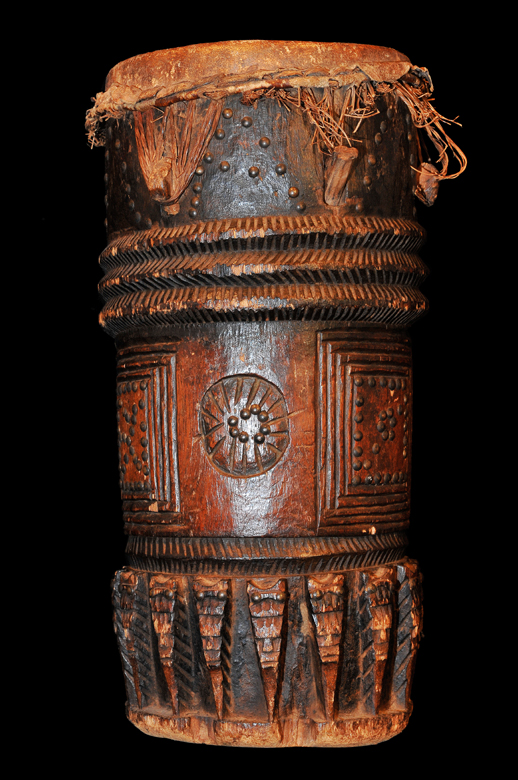
Attié (Akye) Drum / Trommel / Tambour – Ivory Coast

The Attié (Akye) are an Akan-speaking people who live predominantly in southeastern Ivory Coast. Like many Akan societies, they developed highly sophisticated musical traditions in which drums occupy a central position within social, political, and ceremonial life.

This beautifully carved cylindrical drum reflects the remarkable artistic and musical heritage of the Akan cultural sphere. The body is divided into several decorative zones characterized by geometric relief carving, rows of brass tacks, concentric circular motifs, and braided ornamental bands. The visual organization of the instrument demonstrates the close relationship between sculpture, symbolism, and musical performance that is characteristic of many Akan artistic traditions.

Particularly striking is the carefully structured arrangement of decorative elements. The central circular motif resembles a stylized sun, wheel, or rosette and is framed by symmetrical panels that emphasize balance and formal order. The lower section is decorated with deeply carved vertical motifs that create a powerful sculptural rhythm and visually reinforce the cylindrical form of the instrument.

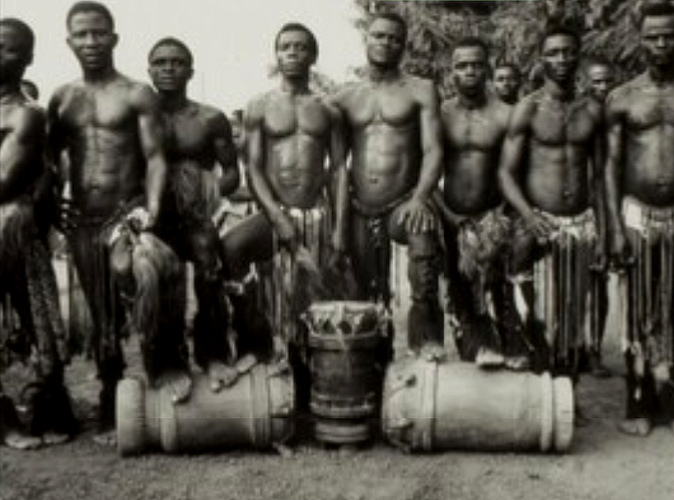
Within Akan societies, drummers traditionally occupied a highly respected social position. Their responsibilities extended far beyond the production of rhythm. Drummers participated in rituals, public ceremonies, royal courts, community celebrations, funerals, festivals, and social gatherings. They functioned as custodians of musical knowledge, transmitters of tradition, and mediators between performers and audiences.

The role of the drummer was often hereditary. Musical knowledge, repertories, ceremonial responsibilities, and specialized performance techniques were commonly transmitted from one generation to the next. In many communities, drumming represented not only a profession but also an inherited social function associated with prestige, responsibility, and cultural continuity.

Historically, Akan drumming developed into one of the most sophisticated musical systems in West Africa. Distinct drum ensembles fulfilled different ceremonial purposes and accompanied dance performances, political ceremonies, religious observances, and important life-cycle events. Music, movement, and social interaction formed an inseparable cultural unit in which rhythm structured both communal participation and social organization.

From an organological perspective, the instrument belongs to the family of single-headed membranophones carved from a single wooden trunk and covered with animal skin. The combination of carved ornamentation and metal appliqué reflects the importance of visual aesthetics within Akan material culture.

As an art object, this drum illustrates the extraordinary integration of music and sculpture in West African traditions. It simultaneously embodies craftsmanship, performance, social identity, and symbolic expression. The instrument therefore occupies an important position at the intersection of ethnomusicology, anthropology, ritual studies, and African art history.

Original quotation

"The drummer is an important person in certain forms of Akan social life—in leisure, ritual and ceremonial situations of village and town communities, bands, associations and courts. Accordingly he is a member of various organisations from which he derives his peculiar duties as well as status and privileges (...)"

"All drummers (...) are expected to know their art and the duties required of them, to maintain a reasonable standard of performance and to be ready to perform whenever called upon to do so (...)"

"The duties of a drummer are passed on from father to son, for it is believed that if a person's father is a drummer, he inherits his father's skill and he is able to learn the art with ease (...)"

"Furthermore, between drummers, dancers and listeners, there is supposed to be a bond of mutual respect and goodwill, also essential to the success of the dance situation."

Excerpt from: Nketia, J. H. K. (1954). "The Role of the Drummer in Akan Society." African Music: Journal of the African Music Society.

Literature / References

Nketia, J. H. K. (1963): Drumming in Akan Communities of Ghana.
Nketia, J. H. K. (1954): "The Role of the Drummer in Akan Society." African Music, 1(1), 34–43.
Rattray, Robert Sutherland (1927): Religion and Art in Ashanti. London: Oxford University Press.
zurück