Africa
Kuba drum Ngeende (Kuba Kingdom, Democratic Republic of the Congo)
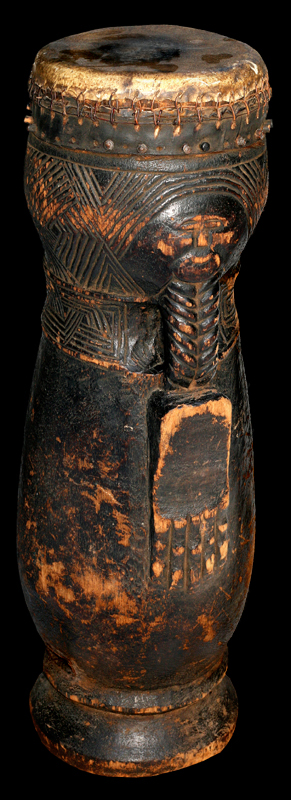
Kuba Drum Ngeende(Kuba Kingdom, Democratic Republic of the Congo)
Among the royal cultures of Central Africa, the Kuba Kingdom developed one of the most distinctive artistic traditions on the African continent. Situated between the Kasai and Sankuru rivers in the present-day Democratic Republic of the Congo, the kingdom became renowned for its sophisticated court culture, monumental architecture, textile production, woodcarving, metalworking, and ceremonial arts. Musical instruments occupied an important position within this artistic environment, and drums became powerful symbols of political authority, dynastic legitimacy, and social prestige.
The present drum belongs to a characteristic group of royal Kuba drums documented in numerous museum collections and early ethnographic publications. These instruments were traditionally associated with kings and regional chiefs and were used during official ceremonies, court performances, public gatherings, and other occasions emphasizing political authority. Unlike many other African drums that primarily fulfilled musical functions, Kuba drums frequently served as visual manifestations of rank and social distinction.
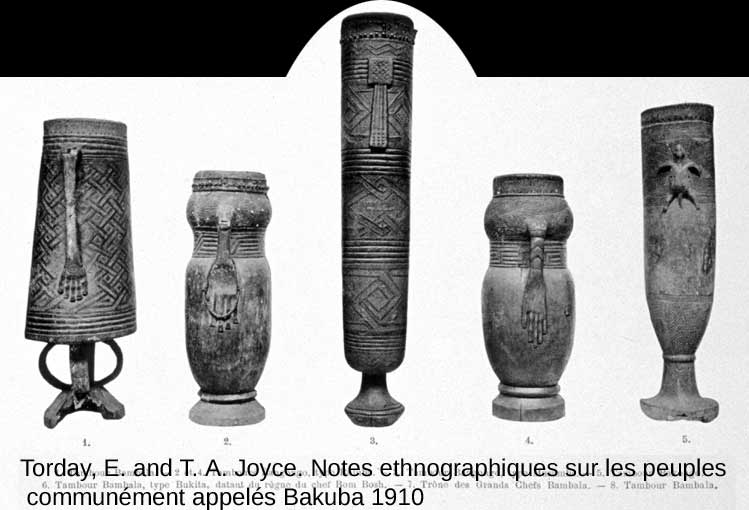
One of the most remarkable features of this instrument is the sculptural composition carved directly into the drum body. A carefully modeled human face appears above a prominently carved hand, while geometric incised patterns decorate the upper section of the resonator. Comparable examples were documented by Émile Torday and T. A. Joyce during their ethnographic research among the Kuba in the early twentieth century and later illustrated in Olga Boone's comprehensive study of Congolese drums.
According to Olga Boone, the carved hand may reflect an older social practice in which a distinguished individual could only be admitted to the society of great warriors after presenting the severed hand of a defeated enemy. Although the precise interpretation of this motif remains a subject of scholarly discussion, the symbolic association between the hand, military achievement, and political status appears repeatedly in Kuba material culture. The placement of the hand beneath the human face further reinforces the impression that the drum functioned not only as a musical instrument but also as a symbolic representation of power and authority.
From an organological perspective, the instrument belongs to the family of single-headed cylindrical membranophones. Kuba drums are particularly recognizable because of their distinctive method of attaching the drumhead. Instead of directly fastening the membrane to the wooden body, a separate leather strip is first wrapped around the upper edge and secured with nails. The membrane is subsequently stitched to this leather band, creating a construction technique that distinguishes Kuba drums from many neighboring Central African drum traditions.
The exceptional quality of Kuba woodcarving has long attracted the attention of collectors, ethnographers, and museum curators. Instruments such as the present example demonstrate the impossibility of separating music from sculpture within Central African court culture. The drum simultaneously preserves artistic traditions, political symbolism, historical memory, and ceremonial practice. As a result, royal Kuba drums must be understood not merely as musical instruments but as complex cultural objects situated at the intersection of art, authority, and ritual.
"The best-known drums of the region come from the Kuba kingdom, situated between Kasai and Sankuru. Their skins are attached using a characteristic technique. A strip of leather is placed around the top of the body and nailed to it; the skin is then stitched to the leather strip. Particularly elaborate instruments have a handle on the body carved in the shape of a hand, above which is often a face."
Andreas Meyer, Afrikanische Trommeln – West- und Zentralafrika. Berlin, 1997, p. 243.
"The ornaments can be interpreted as signs of an old custom, whereby a distinguished individual could formerly only be accepted into the company of warriors on producing the hand of his slaughtered enemy."
Olga Boone, Les tambours du Congo Belge et du Ruanda-Urundi. 1951, p. 44.
Boone, Olga: Les tambours du Congo Belge et du Ruanda-Urundi. 2 vols. Tervuren: Annales du Musée du Congo Belge; Ethnographie 1, 1951.
Brincard, M. T.: Sounding Forms – African Musical Instruments. 1989.
Chauvet, Stephen: Musique Nègre. 1929.
Cornet, Joseph: Art from Zaire. 1975.
Dagan, Esther A. (ed.): Drums – The Heartbeat of Africa. Galerie Amrad, 1993.
Meyer, Andreas: Afrikanische Trommeln – West- und Zentralafrika. Staatliche Museen Preußischer Kulturbesitz, Berlin, 1997.
Torday, Émile & Joyce, T. A.: Notes ethnographiques sur les peuples communément appelés Bakuba. 1910.
Wieschhoff, Heinz: Die afrikanischen Trommeln und ihre außerafrikanischen Beziehungen. Stuttgart, 1933.
Musical instruments of the Democratic Republic of the Congo.
Bakpekpe (Budu), Boungou (Lokele), Bugu (Zande), Chondo (Kanyoka), Condo (Luba-Kasai), Dundu (Pygmées), Ebgbge (Pygmées), Emandru (Medje),
Gbugbu (Gbandi, Mayogo), Gogo (Mamvu), Gudugudu (Ndo), Gudu-gudu (Abangba), Gugu (Zande), Igogo (Pygmées), Igogo deja (Budu), Igogo tade (Budu)
Ikokola (Boyela, Ngando), Ikokole (Batwa, Bolia, Ekonda, Twa), Ikole (Mongala), Ikookole (Mongo), Kandji (Ngoma) (Kongo), Kankonko (Sala Mpasu)
Khoko (Kongo), Kiyondo (Songye), Kyondo (Luba), Lenga (Gubu), Lokele (Bongando), Lokole (Batwa, Boyela, Ekonda, Elinga, Enga, Kutu, Mongo, Ndengese
Nkundu, Saka),Lokolé (Mongo, Mputu),Lokombe (Boyela, Ndengese, Tetela),Lokombe (Lukumbe) (Mongo),Lokuku (Ekonda),Lukumbe (Hamba, Mondja,Tetela)
Lunkufi (Songye), Magbo (Mayogo), Makpo (Budu / Mbuti), Makpo (Kpokpo) (Pygmées, Pygmées), Mandru (Mangbetu), Mgungu (Mbuti), Mokoto (Binza)
Molonge (Sengele), Mond (Lunda), Mondo (Kongo, Kwese, Mpangu, Suku, Tshokwe, Yaka), Mongungu (Ngombe), Mpopwo (Bari), Mudimba (Kanyoka, Luba)
Mungungu (Bali), Mutumba (Lunda, Sala Mpasu), Ndundu (Pygmées), Nedundu (Medje), Nekbokbo (Medje), Nekpokpo (Mangbetu), Nemandru (Mangbetu)
Nengwangu (Mayogo), Ngombi (Boa), Ngoto (Lobala), Ngufu (Yaka), Nkoko (Yaka), Nkombe (Lokombe) (Boyela), Nkonko (Kongo), Nkumvi (Luba)
N'kupila (Yaka), Shakudi (Mongo, Tetela), Tshikunvu (Lunda), Tshingoma (Kongo), Tshingufu (Chokwe, Tshokwe), Wungu (Hamba), Yeye (Mayogo)