Basakata Drum Democratic Republic of the Congo
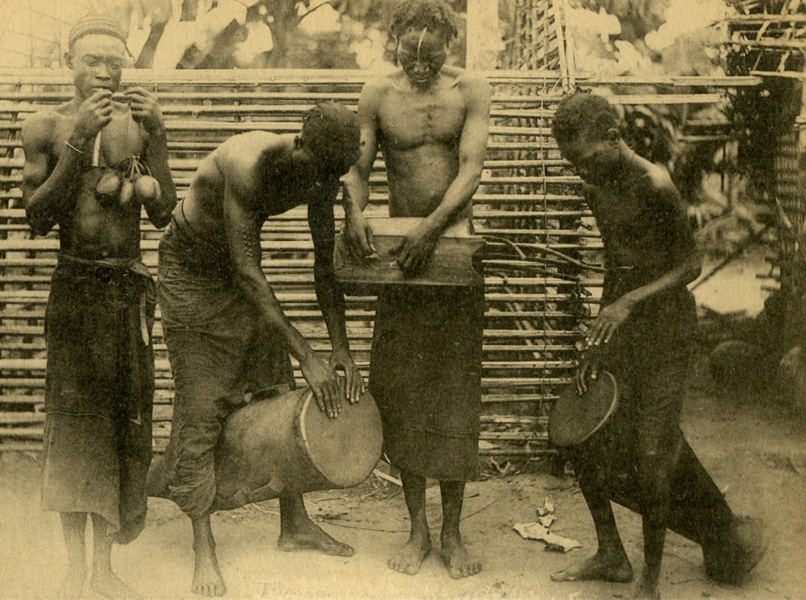
- Le joueur à l’extrême gauche joue une flûte en tenant une série de grelots et, alors que deux tambours de facture différente résonnent à ses côtés, un autre musicien fait vibrer un pluriarc.(EP.0.0.7241, collection MRAC Tervuren ; photo P. Tits (mission J. Maes), 1913-1914 © MRAC Tervuren.)
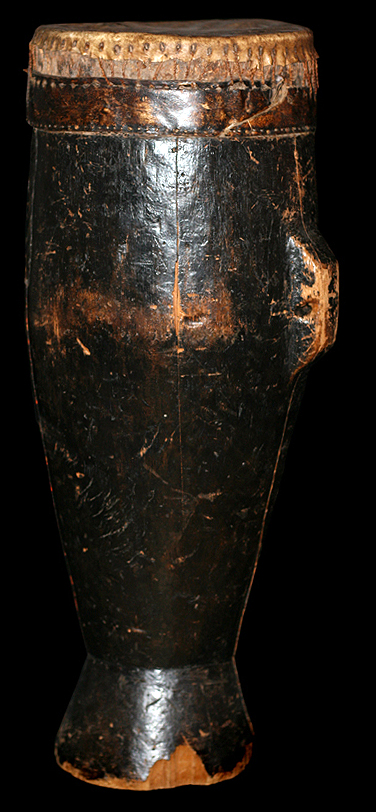
Basakata (Sakata) Drum (Mai-Ndombe, Democratic Republic of the Congo)
This single-headed membranophone belongs to the drum traditions of the Basakata (Sakata) people of the Mai-Ndombe region of the Democratic Republic of the Congo. The form is characteristic of a wider Central African tradition of cylindrical-conical drums documented historically in the area of Lac Léopold II, the present-day Lake Mai-Ndombe. A closely corresponding example is preserved in the collection of the Royal Museum for Central Africa in Tervuren under inventory number MO.0.0.18196. The museum records the object as a cylindrical-conical drum from the Sakata, collected in the former Bandundu area at Lac Léopold II in 1914.
A particularly important organological feature is the method used to attach and tension the membrane. The drum belongs to a regional construction tradition associated with the Lac Léopold II, Lukenie and Kasai area, in which a leather tension band forms part of the system used to secure and tighten the drumhead. J.-N. Maquet described this regional form as belonging to the mixed-tension systems of Congolese drums. The construction is therefore significant not only technically but also geographically, as it links the instrument with a broader organological zone extending from the Mai-Ndombe area towards the Lukenie and Kasai regions.
Historical documentation provides valuable evidence for the musical environment of the Sakata. The collections of the Royal Museum for Central Africa preserve photographs and ethnographic records from the early twentieth century showing Sakata musicians with drums and other instruments. A photograph from the Maes expedition of 1913 documents musicians performing with a drum together with a pluriarc and other musical instruments. Such historical images are particularly important because many instruments collected during this period survive without detailed documentation of their original musical context.
Among the Sakata and Iyembe, a related drum type is documented under the name ndungu. Historical descriptions indicate that such drums could be played with the hand or with a striking stick and could be carried with a braided shoulder strap. In certain documented contexts the drum was associated with warfare and was used to stimulate and encourage warriors. This evidence illustrates the close connection between drums, collective action and social communication in the region, while it should not be taken to mean that every Sakata drum had an exclusively military function.
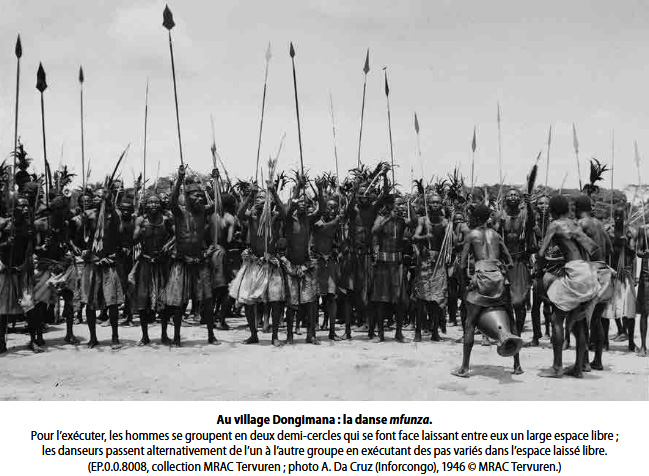
The historical photographs associated with the Mai-Ndombe region also document the importance of collective dance and movement. One photograph taken at Dongimana in 1946 records the mfunza dance. The accompanying description explains that the men form two opposing semicircles, leaving an open space between them in which individual dancers perform alternately. Although the surviving caption does not identify the instruments used in this particular performance, the photograph provides valuable evidence of the social setting in which rhythm, music, movement and collective participation were closely connected.
"Il ne peut cesser de battre son tambour, afin de stimuler et exciter les combattants."
Georges Hulstaert (1935), Notes sur les instruments de musique à l'Équateur, Congo, II, p. 364.
"Le tambour est joué avec la main ou avec une baguette."
Hulstaert, Georges (1935), Notes sur les instruments de musique à l'Équateur, Congo, II.
Bibliography:
Boone, Olga (1951): Les tambours du Congo belge et du Ruanda-Urundi. 2 Vols. Tervuren: Annales du Musée du Congo Belge, Ethnographie 1.
Chauvet, Stephen (1929): Musique Nègre.
Hulstaert, Georges (1935): Notes sur les instruments de musique à l'Équateur. Congo, II, pp. 354–375.
Kœchlin, Basile (2019): "Les traditions musicales du Mai-Ndombe." In: Mai-Ndombe. Mosaïque de peuples établie sur un patrimoine naturel. Tervuren: Royal Museum for Central Africa.
Maquet, J.-N. (1957): Note sur les instruments de musique congolais. Mémoires de l'Académie royale des Sciences coloniales, Sciences morales et politiques, Nouvelle Série, Tome VI, fascicule 4.
Wieschhoff, Heinz (1933): Die afrikanischen Trommeln und ihre außerafrikanischen Beziehungen. Stuttgart.
Royal Museum for Central Africa, Tervuren: Basakata / Sakata cylindrical-conical drum, inventory no. MO.0.0.18196. Collection record: Democratic Republic of the Congo, Bandundu, Mai-Ndombe, Lac Léopold II. Acquired 14 May 1914.