Africa
Bena Lulua drum Congo
Bena Lulua Drum (Bena Lulua / Luluwa, Democratic Republic of the Congo)
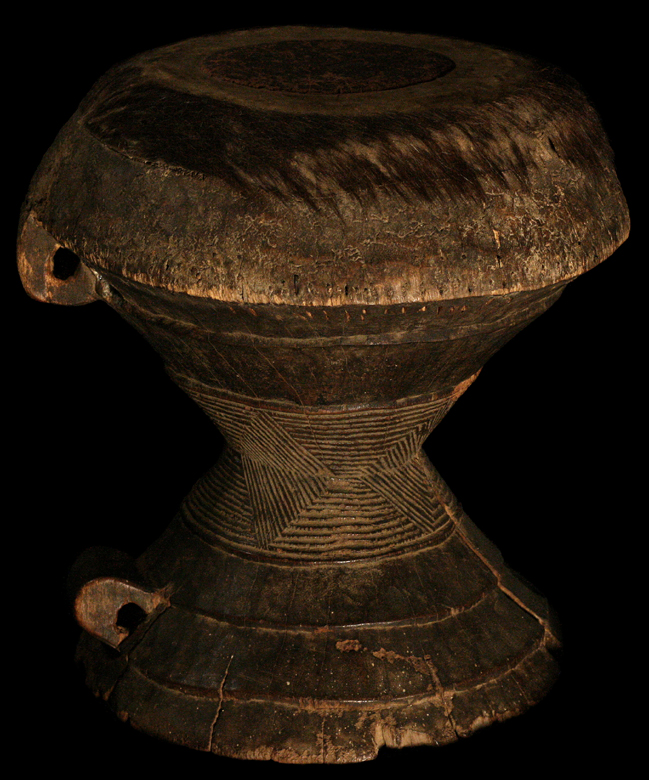
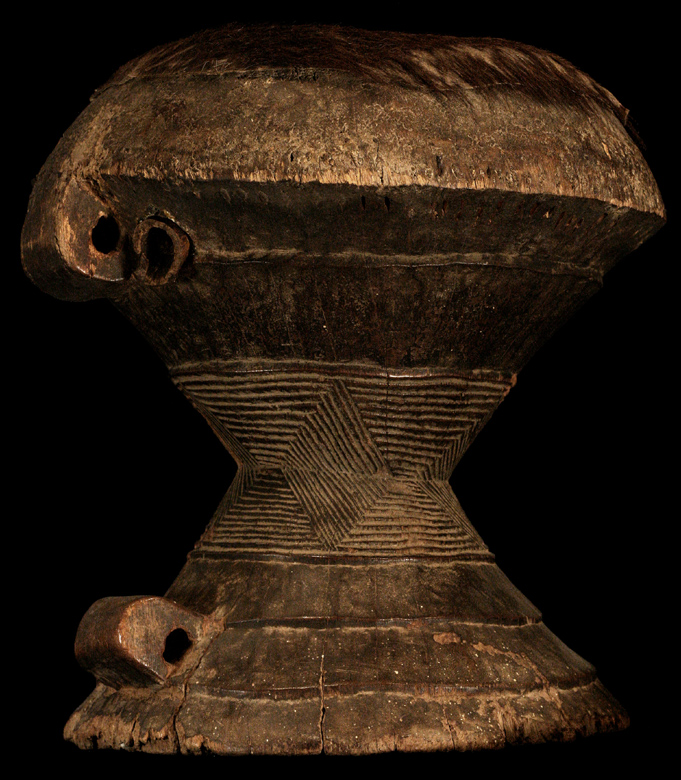
This single-headed membranophone belongs to the musical traditions of the Bena Lulua, or Luluwa, of the Kasai region of the Democratic Republic of the Congo. It is a highly sculptural type of ngoma, carved from a single piece of wood and distinguished by its broad upper and lower sections, narrow waist and strongly developed foot. The body is further articulated by incised geometric ornament, while projecting lateral elements with perforations are incorporated into the wooden structure. Comparable drums are documented among neighbouring peoples of the Kasai region, including Luba and related groups.
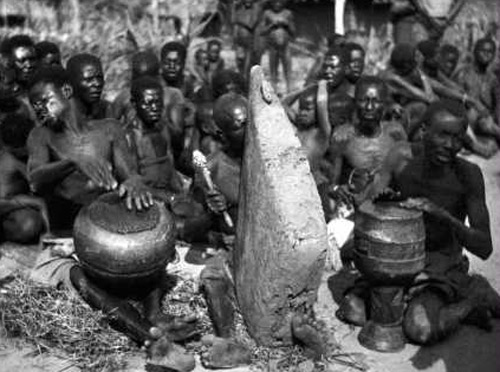
The form of this drum is closely associated with the ceremonial and political life of Central African courts. Earlier documentation records drums of this type in connection with the investiture and funerals of rulers and other high-ranking persons. Their function was therefore not restricted to musical entertainment: the drum formed part of the ceremonial soundscape surrounding political authority, succession and the public commemoration of important individuals. Similar forms were also used by neighbouring peoples, reflecting the extensive musical and cultural relationships of the Kasai region.
The drum is equipped with a kikolo mirliton, a secondary vibrating membrane that produces the characteristic buzzing resonance of the instrument. The kikolo consists of a small section of calabash fitted into an opening in the drum body and covered with a delicate membrane made from the protective material of a spider egg sac. When the drum is played, this membrane vibrates sympathetically with the sound of the main drumhead, adding a distinctive buzzing and slightly nasal resonance to the deep tone of the drum. Mirlitons are found on a number of Central African drums and are highly valued for the distinctive resonance they contribute to ceremonial and ensemble music. In the present instrument, the kikolo is therefore an integral acoustic component of the drum and not merely a structural or decorative feature.
A second important acoustic modification is visible on the main membrane. A compact resinous or otherwise adhesive mass has been applied to the skin. Adding such a mass increases the effective mass of the membrane and alters its modes of vibration. The membrane consequently responds with a lower and more subdued sound, while some of its higher partials are damped. The treatment can therefore be understood as an intentional method of modifying the tonal character of the drum and producing a deeper, heavier resonance.
The combination of the kikolo mirliton and the additional mass on the membrane demonstrates a sophisticated practical understanding of drum acoustics. The sound of the instrument is determined not only by the dimensions of its wooden body and the tension of the skin, but also by deliberate modifications of the vibrating membrane and the addition of a secondary resonating surface. The resulting sound combines a deep fundamental character with the characteristic buzzing resonance of the mirliton.
The elaborate treatment of the wooden body is equally significant from an art-historical perspective. The narrow waist is covered with dense linear and geometric incisions, while the broad upper and lower sections are comparatively restrained. The decoration follows the architectural structure of the instrument and emphasizes its powerful hourglass-like silhouette. The combination of sculptural form, geometric ornament and complex acoustic construction demonstrates the high artistic and technical importance that could be given to ceremonial drums in the Kasai region.
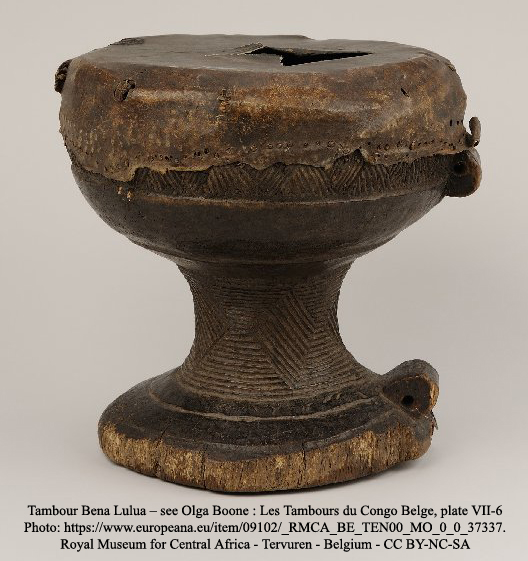
Historical museum documentation confirms the antiquity and wider distribution of this drum form. Olga Boone included comparable Luluwa drums in her major study of drums from the former Belgian Congo and Ruanda-Urundi. A Luluwa ngoma from the Kasai region, collected in 1939 and preserved in the Royal Museum for Central Africa, is also documented in later research. Comparable forms occur among neighbouring Luba, Songye, Tetela and other peoples of the central Congo, demonstrating that the instrument belongs to a broader regional tradition while retaining its particular Luluwa associations.
The Bena Lulua drum is therefore an instrument in which ceremonial authority, sculptural craftsmanship and sophisticated sound production converge. Its deepened membrane sound and the characteristic buzzing of the kikolo give it a powerful acoustic identity, while its carefully carved body reflects the artistic traditions of the Kasai region. In ceremonial contexts, these combined qualities would have contributed to the distinctive and authoritative sound of the ngoma.
"RMCA 38828, Luluwa, Kasai, 52 x 35cm., collected 1939 (Boone plate VIII/34, 'ngoma')."
John M. Janzen, Ngoma: Discourses of Healing in Central and Southern Africa, University of California Press, 1992, catalogue of Central African ngoma drums and museum examples. The Luluwa example is identified as RMCA 38828 and is documented as having been collected in 1939 and published by Olga Boone.
Bibliography:
Boone, Olga (1951): Les tambours du Congo Belge et du Ruanda-Urundi. 2 vols. Tervuren: Annales du Musée du Congo Belge, Sciences de l'Homme – Ethnographie, Vol. 1.
Brincard, Marie-Thérèse (1989): Sounding Forms – African Musical Instruments.
Dagan, Esther A. (1993): Drums – The Heartbeat of Africa. Westmount, Québec: Galerie Amrad.
Gansemans, Jos (1980): Les instruments de musique Luba (Shaba, Zaïre). Tervuren: Musée royal de l'Afrique centrale.
Janzen, John M. (1992): Ngoma: Discourses of Healing in Central and Southern Africa. Berkeley: University of California Press.
Laurenty, Jean-Sébastien (1972): "Les membranophones des Luba-Shankadi." African Music: Journal of the International Library of African Music, Vol. 5, No. 2, pp. 40–45.
Maes, Joseph (1937): Sculpture décorative ou symbolique des instruments de musique du Congo Belge.
Meyer, Andreas (1997): Afrikanische Trommeln – West- und Zentralafrika. Berlin: Staatliche Museen zu Berlin – Preußischer Kulturbesitz.
Wieschhoff, Heinz (1933): Die afrikanischen Trommeln und ihre außerafrikanischen Beziehungen. Stuttgart.