DRUMS OF THE WORLD
bougarabou drum senegal
Bougarabou drum / Trommel / Tambour
Jola (Diola) – Senegal, The Gambia and Guinea-Bissau
The Bougarabou is one of the most distinctive drums of the Jola (Diola) people of the Casamance region in southern Senegal and neighboring areas of The Gambia and Guinea-Bissau. Although it remains less well known internationally than the Djembé, the instrument occupies a central position within Jola musical culture and represents one of the most sophisticated solo drumming traditions in West Africa.
The Jola are among the oldest populations of the Senegambian region and developed cultural traditions that differ in many respects from those of the neighboring Mande-speaking societies. Unlike the Djembé, which evolved within the Mande cultural sphere and is generally performed within larger ensembles, the Bougarabou developed as an independent drumming tradition characterized by the performance of a single musician playing one or several drums simultaneously.
Historically, Bougarabou performances accompanied important communal events, including harvest celebrations, weddings, naming ceremonies, initiation rituals, and funerary observances. These performances often continued throughout the night and served not only as musical entertainment but also as a mechanism for reinforcing social relationships and strengthening community identity. Music, dance, singing, and audience participation formed an inseparable cultural unit.
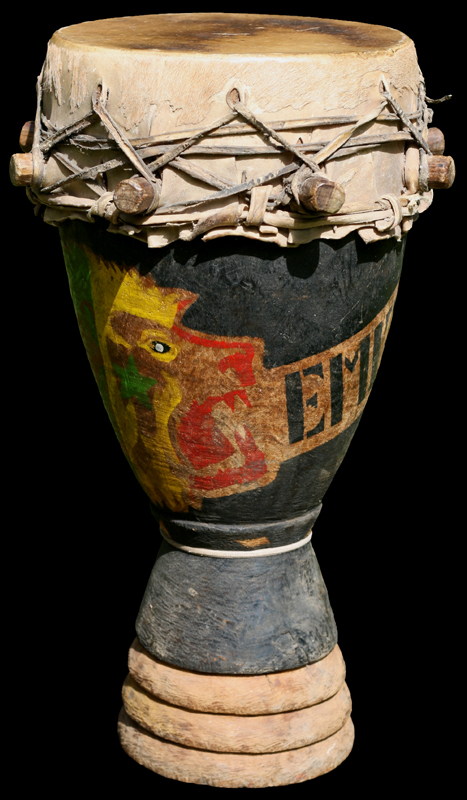
Organologically, the Bougarabou belongs to the family of single-headed goblet-shaped drums. Traditionally, the shell is carved from a single piece of hardwood and covered with calfskin or cowhide. Unlike modern rope-tuned drums, older examples frequently employed leather strips and wooden tuning pegs to secure the drumhead. The membrane was tightened by inserting or adjusting wooden pegs and by briefly heating the drum near an open fire, causing the skin to contract and temporarily increase the pitch.
The present example preserves several important traditional construction features. The drumhead is attached with leather lacing and individually inserted wooden pegs, representing an older tuning technique that predates the widespread adoption of synthetic rope systems. The painted decoration on the shell is unusual and reflects the continuing evolution of these instruments within contemporary performance culture. The elongated profile of the drum produces a deeper and more resonant tone than that of the Djembé, resulting in a sound that is often compared to that of the Cuban conga.
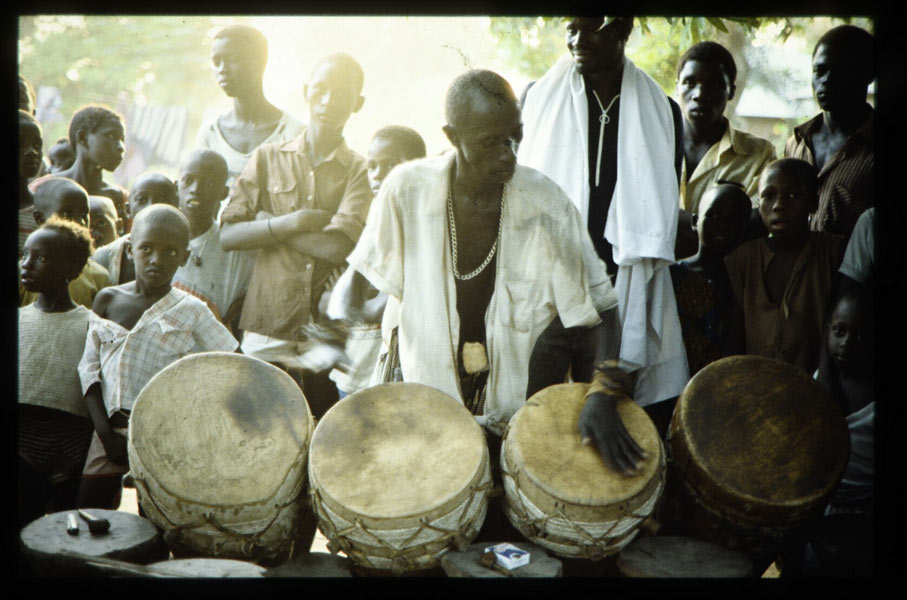
A characteristic feature of Bougarabou performance is the use of several differently tuned drums arranged around a single player. Each drum contributes a specific tonal register, allowing the performer to create interlocking rhythmic and melodic patterns simultaneously. This approach differs fundamentally from many other West African drumming traditions, where individual rhythmic parts are distributed among several musicians.
The rhythmic structure of Jola music reflects a highly developed aesthetic in which sound, movement, and social interaction are closely interconnected. Handclapping, singing, dancing, and the use of metal bracelets worn by the drummer frequently contribute additional rhythmic layers, producing a rich and dynamic acoustic environment.
During the twentieth century, the Bougarabou gained wider recognition through field recordings and the international activities of master drummers from Casamance and The Gambia. Among the most influential musicians was Saikouba Badjie, whose recordings documented a tradition that had previously remained largely unknown outside West Africa.
From an art-historical perspective, the Bougarabou demonstrates the remarkable diversity of African drum cultures. Its elegant proportions, distinctive tuning system, and unique performance practice challenge the widespread assumption that West African drumming follows a single musical model. Instead, the instrument reveals a complex regional tradition in which craftsmanship, social organization, ritual life, and artistic expression are inseparably connected.
Donated by my friend, the percussionist Hannes Hausdörfer
Bibliography:
Hale, Thomas A. (1998) Griots and griottes. Bloomington: Indiana University Press.
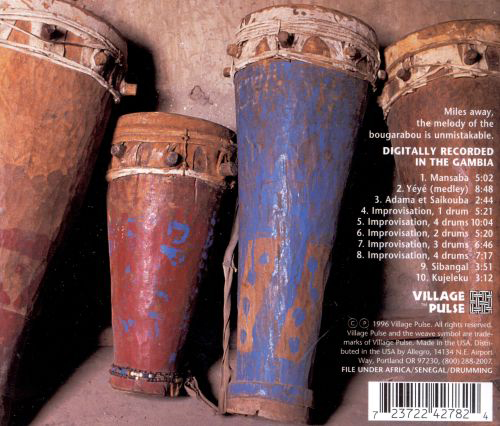
CD: Saikouba Badjie – Bougarabou: Solo Drumming of Casamance.
Village Pulse (www.villagepulse.com)
"The Jola people of Casamance say that the bougarabou drum first came to them in a dream. When you listen to this recording of drumming by master Jola drummer Saikouba Badjie, you can appreciate the mystery and importance placed on this humble but powerful drum, the focal point of their music and dance traditions. Saikouba earns his living drumming for communities of his native Jola people in Casamance (the southwestern region of Senegal) and in neighboring regions of the Gambia and Guineé-Bissau. This field recording, captured with excellent clarity in 1994 in Gambia, showcases Saikouba's mastery of the Jola bougarabou drumming tradition. The drums are played to accompany dancing that celebrates the harvest, marriages, naming ceremonies and funerals of elder women. Performances typically start in the evening and continue through to daybreak-the drummers performing non-stop while being fed by an assistant who also mops the sweat from their brow. Today, the djembe, with origins in Guinea, is the most well-known West African drum outside Africa. The bougarabou is a relative of the djembe, with some important differences. The bougarabou usually has a calf skin head (rather than goat skin). Combined with the drum's taller and narrower profile, it creates a rounder, mellower tone, somewhat like the Cuban conga drum. Another significant difference is that while djembe music (and most West African drum music, for that matter) is played by groups of drummers with one person per drum, bougarabou music is played by one drummer, performing on up to four drums at once, accompanied only by the singing and clapping of the dance circle.(...)" - Barry Hall
Jola (Diola) – Senegal, The Gambia and Guinea-Bissau
The Bougarabou is one of the most distinctive drums of the Jola (Diola) people of the Casamance region in southern Senegal and neighboring areas of The Gambia and Guinea-Bissau. Although it remains less well known internationally than the Djembé, the instrument occupies a central position within Jola musical culture and represents one of the most sophisticated solo drumming traditions in West Africa.
The Jola are among the oldest populations of the Senegambian region and developed cultural traditions that differ in many respects from those of the neighboring Mande-speaking societies. Unlike the Djembé, which evolved within the Mande cultural sphere and is generally performed within larger ensembles, the Bougarabou developed as an independent drumming tradition characterized by the performance of a single musician playing one or several drums simultaneously.
Historically, Bougarabou performances accompanied important communal events, including harvest celebrations, weddings, naming ceremonies, initiation rituals, and funerary observances. These performances often continued throughout the night and served not only as musical entertainment but also as a mechanism for reinforcing social relationships and strengthening community identity. Music, dance, singing, and audience participation formed an inseparable cultural unit.
Organologically, the Bougarabou belongs to the family of single-headed goblet-shaped drums. Traditionally, the shell is carved from a single piece of hardwood and covered with calfskin or cowhide. Unlike modern rope-tuned drums, older examples frequently employed leather strips and wooden tuning pegs to secure the drumhead. The membrane was tightened by inserting or adjusting wooden pegs and by briefly heating the drum near an open fire, causing the skin to contract and temporarily increase the pitch.
The present example preserves several important traditional construction features. The drumhead is attached with leather lacing and individually inserted wooden pegs, representing an older tuning technique that predates the widespread adoption of synthetic rope systems. The painted decoration on the shell is unusual and reflects the continuing evolution of these instruments within contemporary performance culture. The elongated profile of the drum produces a deeper and more resonant tone than that of the Djembé, resulting in a sound that is often compared to that of the Cuban conga.
A characteristic feature of Bougarabou performance is the use of several differently tuned drums arranged around a single player. Each drum contributes a specific tonal register, allowing the performer to create interlocking rhythmic and melodic patterns simultaneously. This approach differs fundamentally from many other West African drumming traditions, where individual rhythmic parts are distributed among several musicians.
The rhythmic structure of Jola music reflects a highly developed aesthetic in which sound, movement, and social interaction are closely interconnected. Handclapping, singing, dancing, and the use of metal bracelets worn by the drummer frequently contribute additional rhythmic layers, producing a rich and dynamic acoustic environment.
During the twentieth century, the Bougarabou gained wider recognition through field recordings and the international activities of master drummers from Casamance and The Gambia. Among the most influential musicians was Saikouba Badjie, whose recordings documented a tradition that had previously remained largely unknown outside West Africa.
From an art-historical perspective, the Bougarabou demonstrates the remarkable diversity of African drum cultures. Its elegant proportions, distinctive tuning system, and unique performance practice challenge the widespread assumption that West African drumming follows a single musical model. Instead, the instrument reveals a complex regional tradition in which craftsmanship, social organization, ritual life, and artistic expression are inseparably connected.
Donated by my friend, the percussionist Hannes Hausdörfer
Bibliography:
Hale, Thomas A. (1998) Griots and griottes. Bloomington: Indiana University Press.
CD: Saikouba Badjie – Bougarabou: Solo Drumming of Casamance.
Village Pulse (www.villagepulse.com)
"The Jola people of Casamance say that the bougarabou drum first came to them in a dream. When you listen to this recording of drumming by master Jola drummer Saikouba Badjie, you can appreciate the mystery and importance placed on this humble but powerful drum, the focal point of their music and dance traditions. Saikouba earns his living drumming for communities of his native Jola people in Casamance (the southwestern region of Senegal) and in neighboring regions of the Gambia and Guineé-Bissau. This field recording, captured with excellent clarity in 1994 in Gambia, showcases Saikouba's mastery of the Jola bougarabou drumming tradition. The drums are played to accompany dancing that celebrates the harvest, marriages, naming ceremonies and funerals of elder women. Performances typically start in the evening and continue through to daybreak-the drummers performing non-stop while being fed by an assistant who also mops the sweat from their brow. Today, the djembe, with origins in Guinea, is the most well-known West African drum outside Africa. The bougarabou is a relative of the djembe, with some important differences. The bougarabou usually has a calf skin head (rather than goat skin). Combined with the drum's taller and narrower profile, it creates a rounder, mellower tone, somewhat like the Cuban conga drum. Another significant difference is that while djembe music (and most West African drum music, for that matter) is played by groups of drummers with one person per drum, bougarabou music is played by one drummer, performing on up to four drums at once, accompanied only by the singing and clapping of the dance circle.(...)" - Barry Hall