Dan slit drum / slit gong / Ivory Coast and Liberia
Dan slit drum / slit gong / Schlitztrommel / tambour à fente – Ivory Coast and Liberia
The slit drum of the Dan people is a hollowed wooden idiophone traditionally used in the forest regions of present-day Ivory Coast and Liberia. Unlike membranophones, which produce sound through vibrating membranes, slit drums create sound through the resonance of the wooden body itself.
Among the Dan, music, dance, masquerade and sculpture form an inseparable cultural complex. Musical instruments are not isolated objects but components of a broader artistic and social system in which sound, movement and visual expression interact during public performances and ceremonial events.
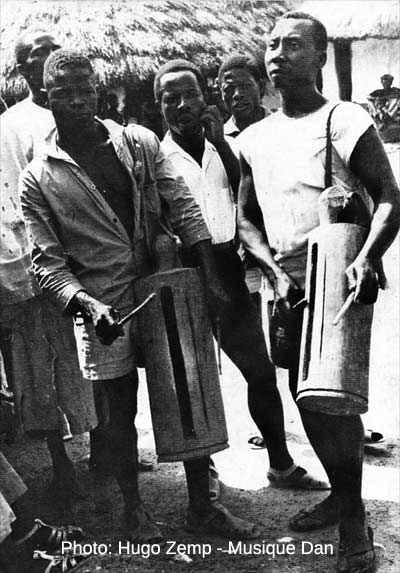
Dan slit drums are frequently associated with masked dances and communal celebrations. Their penetrating sound allows them to accompany dancers in open spaces and to support rhythmic patterns during performances. In some contexts, slit drums may also serve communicative functions within villages and settlements.
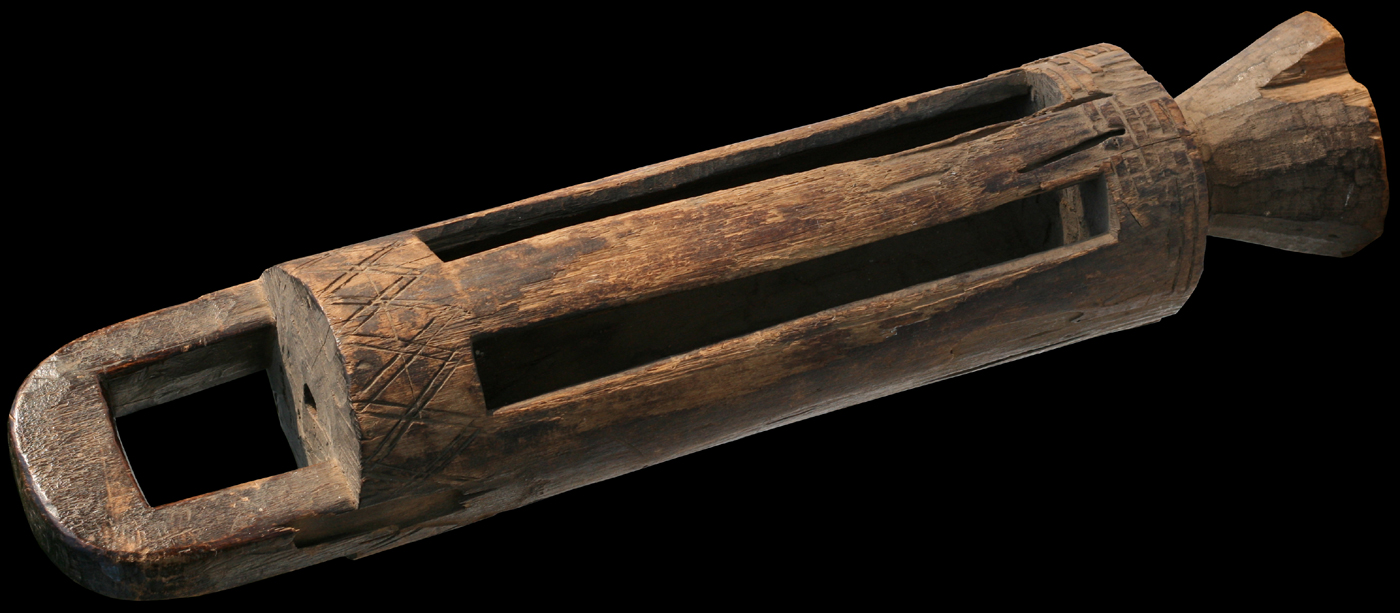
The instrument illustrated here demonstrates remarkable craftsmanship. The elongated body is carefully hollowed and provided with several sound slits that create different resonating chambers. Geometric incisions carved into the surface emphasize that the instrument was not merely a musical tool but also a carefully designed artistic object.
The close relationship between music and visual art is one of the most characteristic features of Dan culture. Masks, drums, slit gongs and other ceremonial objects belong to the same aesthetic tradition and reflect a highly developed artistic vocabulary that has attracted the attention of ethnographers, ethnomusicologists and art historians for more than a century.
The historical photograph by Hugo Zemp documents the use of slit drums in performance practice and illustrates the continuing importance of these instruments within Dan musical culture.
Original quotations:
"The Dan use a wide variety of instruments, but idiophones and membranophones are predominant."
"Music accompanies masked dances and secular entertainment."
Literature / References:
Zemp, Hugo. Musique Dan. La musique dans la pensée et la vie sociale d'une société africaine.
Fischer, Eberhard; Himmelheber, Hans. Die Kunst der Dan. Museum Rietberg, Zürich.
Honoré Naber, S.P.L.; Moret, J. Op expeditie met de Franschen. Reisherinneringen aan de Fransch-Liberiaansche Grensregelings-Expeditie in de jaren 1908 en 1909.