Africa
Antique Djembe Drum Guinea
Guinea – Mande cultural region (Guinea, Mali, Burkina Faso, Côte d'Ivoire, Senegal, Gambia)
The Djembé is one of the best-known African drums worldwide and has become a global symbol of West African musical culture. Historically rooted in the Mande cultural sphere, particularly in Guinea and Mali, the instrument developed within a musical tradition in which drumming, dancing, singing, and communal participation are closely interconnected.
The historical development of the Djembé is closely associated with the Mande cultural world and with hereditary blacksmiths known as Numu. In the older handcraft tradition, specialised blacksmiths produced the wooden shell, while the drummers who owned the instruments were responsible for mounting, fastening, and tuning the membrane. The shell was carved from a solid block of wood and shaped into the characteristic goblet form, consisting of a broad bowl, a pronounced transition, and a narrower cylindrical stem. Because traditional Djembés could remain in use for decades, their manufacture was highly individualised, with each instrument representing a particular combination of craftsmanship, wood, dimensions, membrane, and playing history.(cf. Charry, 2000; Polak, 2004).
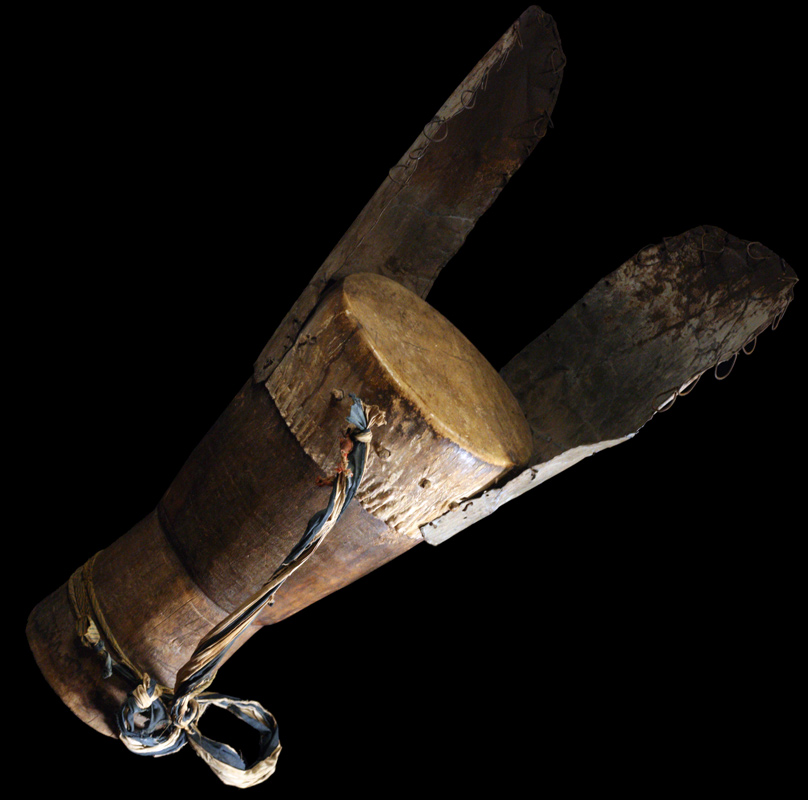
The present instrument is particularly significant because it preserves an older traditional form of membrane attachment known as wooden-peg tensioning or nailing. Small wooden pegs are driven through the moist animal hide into prepared holes in the wooden shell. The hide is stretched by hand while still wet and held in position by the pegs as it dries. This traditional construction differs fundamentally from the metal-ring and synthetic-rope tensioning systems found on most modern Djembés.
Ethnomusicologist Rainer Polak identifies nailing and sewing as the two principal traditional methods of attaching Djembé membranes that were still in use until the 1970s. He describes the nailing technique as the insertion of small wooden pins through the moist hide into pre-drilled holes in the shell.
The survival of this construction on the present instrument is therefore of considerable organological interest. It preserves a form of Djembé technology that has become rare and demonstrates that the instrument's traditional construction was not limited to the modern high-tension system. The relatively low tension obtainable with wooden pegs also influenced the practical playing technique. Before and during performances, the membrane could be heated over a fire. The heat caused the hide to contract temporarily, increasing its tension and restoring loudness and tonal definition.
Another particularly striking feature of this Djembé is its unusually large Kessing rattling elements. These metal elements function as idiophonic sound-producing devices. When the drum is played, they vibrate and produce a pronounced metallic rattling or buzzing sound alongside the tones of the membrane. They are therefore not merely decorative but form part of the instrument's acoustic design.
The combination of traditional wooden-peg membrane attachment and unusually large Kessing elements gives this Djembé a distinctive historical and acoustic character. The instrument preserves an older principle of membrane fastening while simultaneously demonstrating the importance of additional sound-producing devices in West African drum construction. These features make it particularly valuable for understanding the technological and musical diversity of the Djembé before modern tensioning systems became dominant.
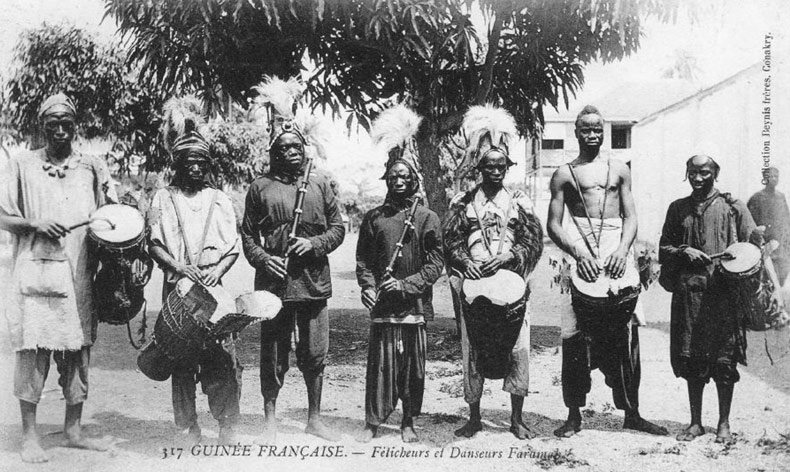
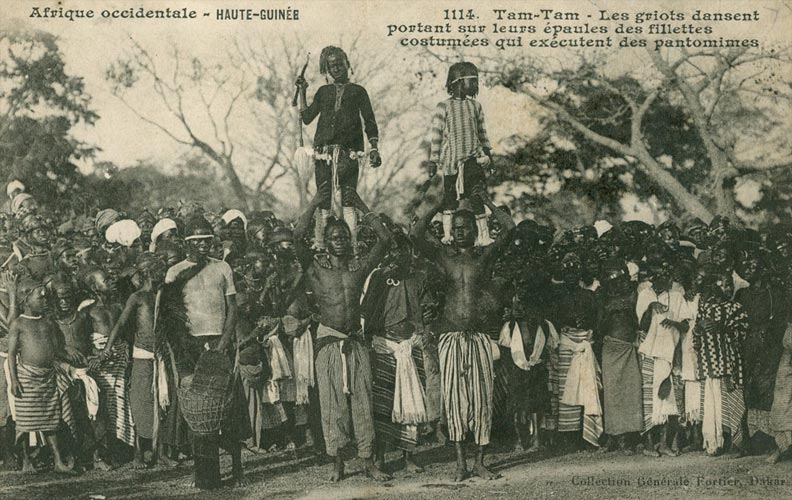
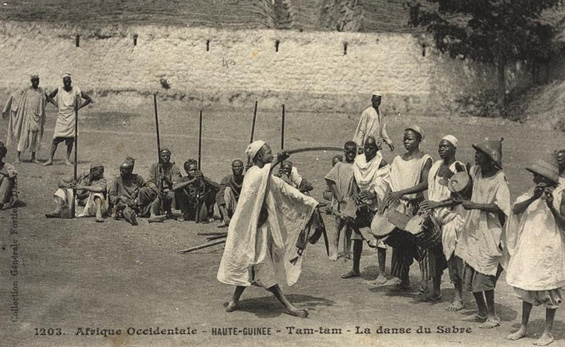
Musically, the Djembé is primarily an ensemble instrument. In the traditions of Guinea and Mali it is commonly performed together with one or more cylindrical bass drums known as dunun. Individual drums contribute complementary rhythmic patterns to a complex interlocking structure, while the lead Djembé player combines established rhythmic phrases with variations and improvisatory accents. The close interaction between drummer and dancer is a central characteristic of traditional performance, with musical phrases often responding directly to movement and gesture.(Polak, 2004, 2014).
Original Quotation
“Beim Nageln werden kleine hölzerne Stifte einfach durch das feuchte, mit der Hand unter Spannung angelegte Fell in vorgebohrte Löcher getrieben.”
Rainer Polak, Die Djembe. Eine Trommel aus Westafrika im Kontext der Globalisierung, 2014, p. 229.
References
Polak, Rainer. Die Djembe. Eine Trommel aus Westafrika im Kontext der Globalisierung. In: Gyula Racz and Hermann Schwandner (eds.), Das große Buch der Schlagzeugpraxis. Regensburg: ConBrio, 2014, pp. 219–239.
Charry, Eric. Mande Music: Traditional and Modern Music of the Maninka and Mandinka of Western Africa. Chicago: University of Chicago Press, 2000.
Chernoff, John Miller. African Rhythm and African Sensibility: Aesthetics and Social Action in African Musical Idioms. Chicago: University of Chicago Press, 1979.
Meyer, Andreas. Afrikanische Trommeln – West- und Zentralafrika. Berlin: Staatliche Museen zu Berlin, Museum für Völkerkunde, 1997.
Polak, Rainer. Festmusik als Arbeit, Trommeln als Beruf: Jenbe-Spieler in einer westafrikanischen Großstadt. Berlin: Reimer Verlag, 2004.
Konaté, Famoudou, and Thomas Ott. Rhythmen und Lieder aus Guinea. Oldershausen: Arun Verlag, 1997.
Djembefolas:
- Arafan Toure
- Fadouba Oularé
- Famoudou Konate
- Fode "Marseille" Youla
- Lamine Soumah
- Laurent Camara
- Mamady Keita
- Ladji Camara
- Seny Toure
- Sekou Camara
- Adama Drame
- Amara Kante
- Gbanworo Keita
- Kassoum Diarra
- Seydou "Sidiki" Conde
- Soungalo Coulibaly
- Zoumana Dembele