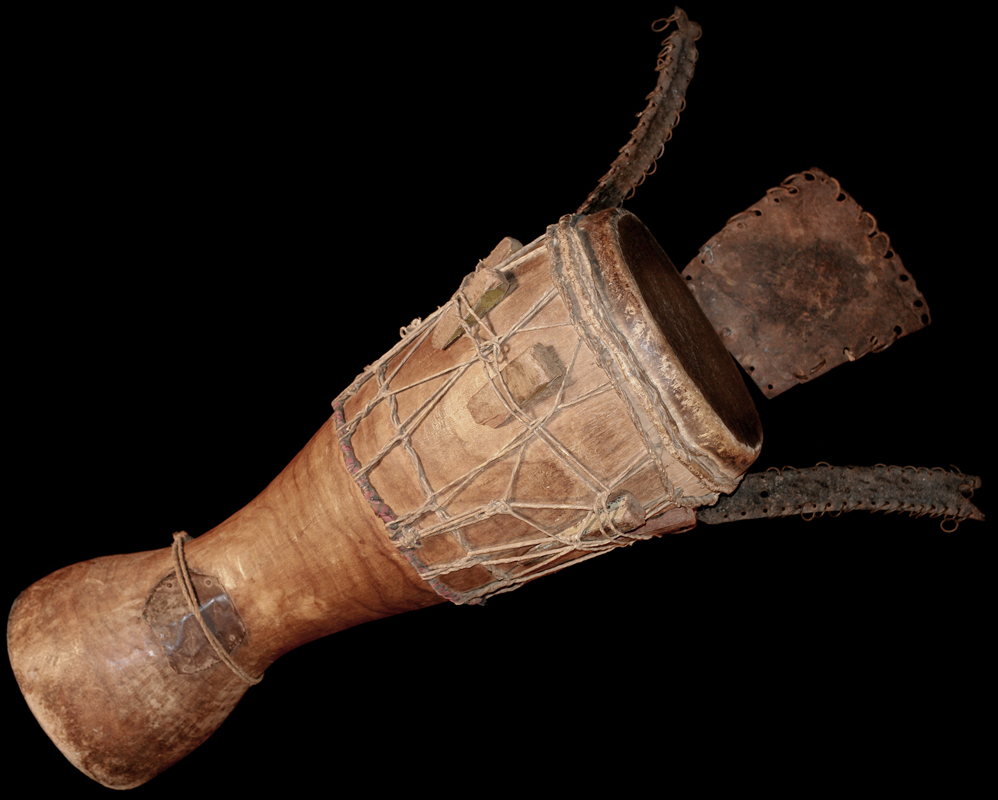
Djembe drum | Membrane is secured by a traditional net-like leather tensioning system | Sierra Leone & Guinea
Guinea – Mande cultural region (Guinea, Mali, Burkina Faso, Côte d'Ivoire, Senegal, Gambia , Sierra Leone)
The Djembé is one of the best-known African drums worldwide and has become a global symbol of West African musical culture. Despite its international popularity, the instrument remains deeply rooted in the social, historical, and artistic traditions of the Mande-speaking peoples of present-day Guinea, Mali, Burkina Faso, Côte d'Ivoire, Senegal, and Gambia.
Most ethnomusicologists associate the historical development of the Djembé with the Mande cultural sphere and, more specifically, with the hereditary blacksmiths known as Numu. Within Mande society, blacksmiths occupied a unique social position. In addition to their expertise in metalworking, they were often regarded as specialists who possessed extensive knowledge of transformation processes, craftsmanship, and ritual practices. The widespread distribution of the Djembé throughout West Africa is frequently associated with the migration and expansion of Mande-speaking populations during the period of the Mali Empire, which flourished from the thirteenth century onward.
Unlike instruments traditionally restricted to hereditary musician families, the Djembé has historically been accessible to a much broader segment of society. Although certain regional performance traditions were transmitted within specific families, the instrument itself was never exclusively reserved for members of the griot caste. This openness contributed significantly to its diffusion across ethnic and political boundaries and ultimately to its remarkable adaptability.
Organologically, the Djembé belongs to the family of goblet-shaped single-headed drums. Traditionally, the shell is carved from a single piece of hardwood and covered with goat skin. Older examples employed leather strips, hide rings, wooden pegs, and various lacing techniques to secure and tension the membrane. Modern instruments generally use synthetic rope systems that permit much higher tension and produce the bright, penetrating sound that has become characteristic of contemporary performance practice.
The present instrument preserves several important historical features. The shell displays the characteristic goblet shape associated with classical West African Djembés, while the membrane is secured by a traditional net-like leather tensioning system. Particularly remarkable are the perforated metal strips attached to the drum. Fitted with numerous metal rings, these elements function as idiophonic sound enhancers that create an additional rattling or buzzing effect during performance. Similar sound-modifying devices are still found on many contemporary West African drums, including the metal rings known as kessing on certain Djembés. These elements are not merely decorative but form an integral part of the instrument's acoustic design.
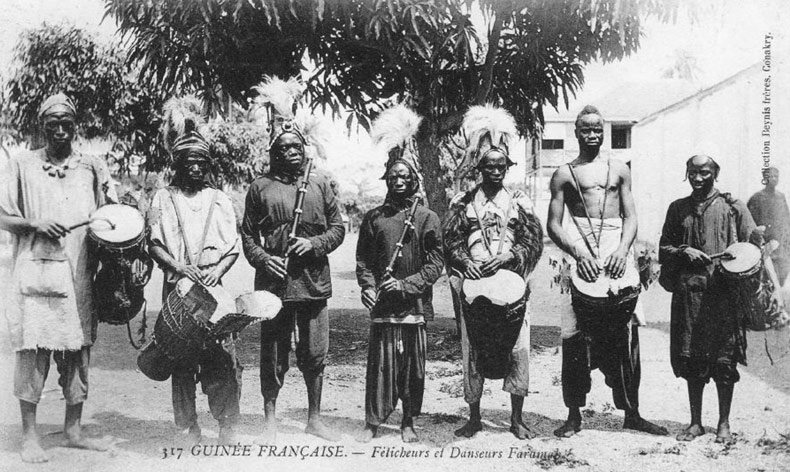
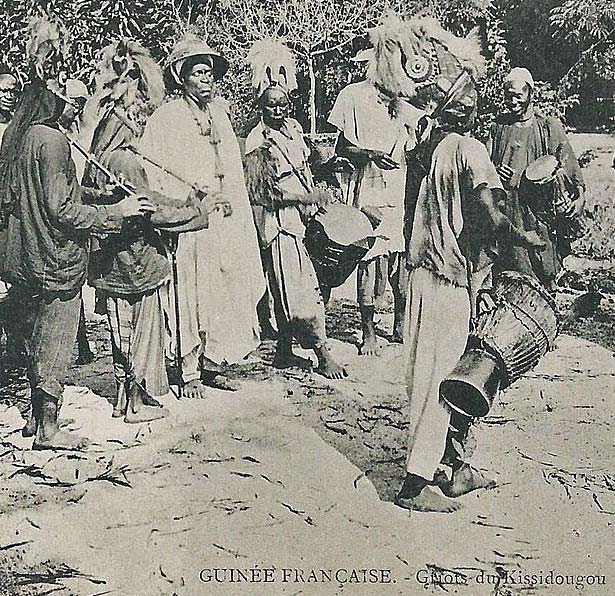
Traditionally, the Djembé is rarely performed as a solo instrument. Instead, it forms part of a larger ensemble that includes one or more cylindrical bass drums known as dunun. Within these ensembles, each instrument performs a specific rhythmic pattern that contributes to a complex polyrhythmic structure. The interaction between accompaniment patterns and improvised solo passages creates a rhythmic framework that supports dance, singing, agricultural work, initiation ceremonies, festivals, and other communal activities.
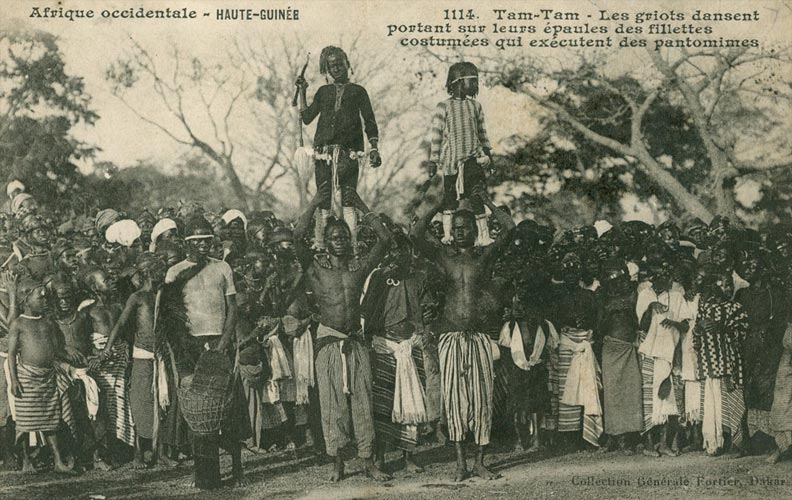
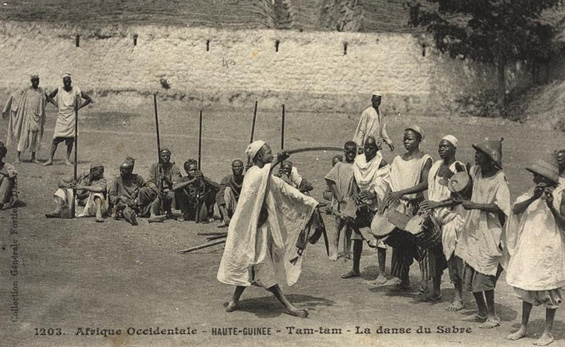
One of the most distinctive characteristics of West African Djembé performance is the close relationship between drummers and dancers. Music is not conceived as an independent artistic performance presented to a passive audience. Instead, all participants contribute actively to the event. Musicians, dancers, singers, and spectators form an integrated community in which roles frequently overlap and continually change. The lead drummer responds directly to the movements of the dancers, emphasizing specific gestures and creating a dynamic dialogue between rhythm and movement.
The international dissemination of the Djembé accelerated during the second half of the twentieth century through the activities of master drummers from Guinea, Mali, and Burkina Faso. Artists such as Famoudou Konaté, Mamady Keïta, Adama Dramé, Fadouba Oularé, and many others introduced traditional Mande drumming to Europe, North America, and Asia, transforming the instrument into one of the most influential percussion traditions of the modern world.
From an art-historical perspective, the Djembé should not be understood merely as a percussion instrument. The sculptural qualities of the carved wooden body, the sophisticated engineering of the tensioning system, and the integration of additional sound-producing devices reveal a highly developed tradition of material culture in which craftsmanship, acoustics, social identity, and artistic expression are inseparably connected.
Original Quotations
"Music is not simply something that people listen to; it is something that people do together."
"The performance of rhythm in West Africa is fundamentally participatory rather than presentational."
"The djembe developed within the cultural world of the Mande peoples and became one of the most important percussion instruments of West Africa."
References
Charry, Eric. Mande Music: Traditional and Modern Music of the Maninka and Mandinka of Western Africa. Chicago: University of Chicago Press, 2000.
Chernoff, John Miller. African Rhythm and African Sensibility: Aesthetics and Social Action in African Musical Idioms. Chicago: University of Chicago Press, 1979.
Meyer, Andreas. Afrikanische Trommeln – West- und Zentralafrika. Berlin: Staatliche Museen zu Berlin, Museum für Völkerkunde, 1997.
Polak, Rainer. Festmusik als Arbeit, Trommeln als Beruf: Jenbe-Spieler in einer westafrikanischen Großstadt. Berlin: Reimer Verlag, 2004.
Konaté, Famoudou, and Thomas Ott. Rhythmen und Lieder aus Guinea. Oldershausen: Arun Verlag, 1997.
djembefolas:
Arafan Toure / Fadouba Oularé / Famoudou Konate / Fode "Marseille" Youla / Lamine Soumah / Laurent Camara / Mamady Keita / Ladji Camara / Seny Toure / Sekou Camara / Adama Drame / Amara Kante / Gbanworo Keita / Kassoum Diarra / Seydou "Sidiki" Conde / Soungalo Coulibaly / Zoumana Dembele