Mokita Drum / Gombe / Doko, Congo-Ubangi Region
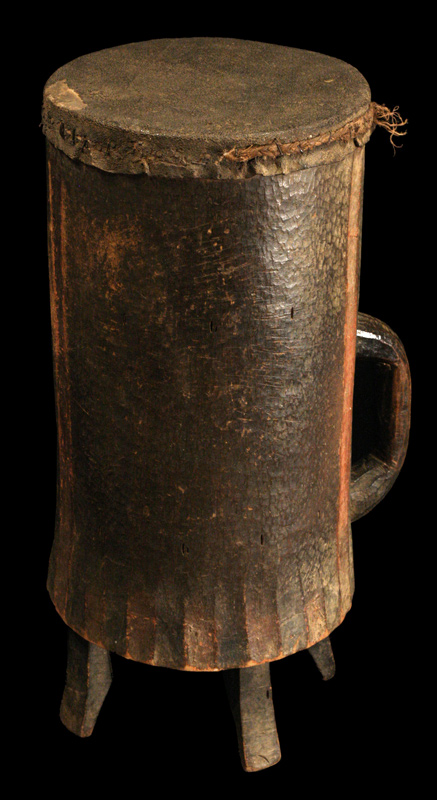
Mokita Drum (Gombe / Doko, Congo-Ubangi Region) | Democratic Republic of the Congo
The Mokita is a distinctive single-headed drum associated by Olga Boone with the Gombe and Doko peoples of the Congo-Ubangi region. Boone illustrates two comparable examples in her fundamental study Les tambours du Congo belge et du Ruanda-Urundi (1951, Pl. IV, nos. 2 and 3). Although her documentation of the instrument is limited, the surviving examples demonstrate a characteristic type of Central African drum distinguished by its cylindrical body, closed base, carved feet, and side handle.
The membrane is attached by a nailed construction. The hide is secured around the upper rim with short wooden or bamboo pegs, producing a form of direct mechanical attachment without the elaborate rope-lacing systems characteristic of many other Central African drums. This construction is also documented on a comparable drum in the collection of The Metropolitan Museum of Art in New York. That instrument, dating from the nineteenth century and catalogued as probably Poto, is likewise a single-headed drum from the Democratic Republic of the Congo and is described as being made of wood, rattan, nail, and hide.
The available historical documentation does not permit a precise reconstruction of the musical or ceremonial use of the Mokita. Its name is nevertheless preserved in modern international musical-instrument terminology, where Mokita is classified among drums. In the absence of more detailed ethnographic evidence, it is important to distinguish the secure identification of the instrument from assumptions concerning its former performance context. The present example is therefore particularly valuable as material evidence for the diversity of drum construction in the Congo-Ubangi region.
The Mokita is significant not only because of its rarity in documented collections, but also because of the close relationship between its structural and aesthetic features. The resonator, feet, handle, surface ornamentation, and membrane attachment were conceived as parts of a single carved form. Together with the examples published by Boone and the comparable nineteenth-century drum preserved at The Metropolitan Museum of Art, the instrument contributes to the documentation of a regional Central African drum tradition whose historical and musical diversity remains only partially recorded.
References
Boone, Olga (1951): Les tambours du Congo belge et du Ruanda-Urundi. Tervuren: Musée du Congo belge.1951. Pl. IV, nos. 2–3.
European Musical Instrument Museums Online (MIMO): A list of instrument names and synonyms in French and English. Mokita listed under Percussion – Drums.
The Metropolitan Museum of Art, New York: Drum, probably Poto people. Democratic Republic of the Congo, 19th century. Object No. 89.4.510. The Crosby Brown Collection of Musical Instruments, 1889.