Africa
Gelede drum Yoruba
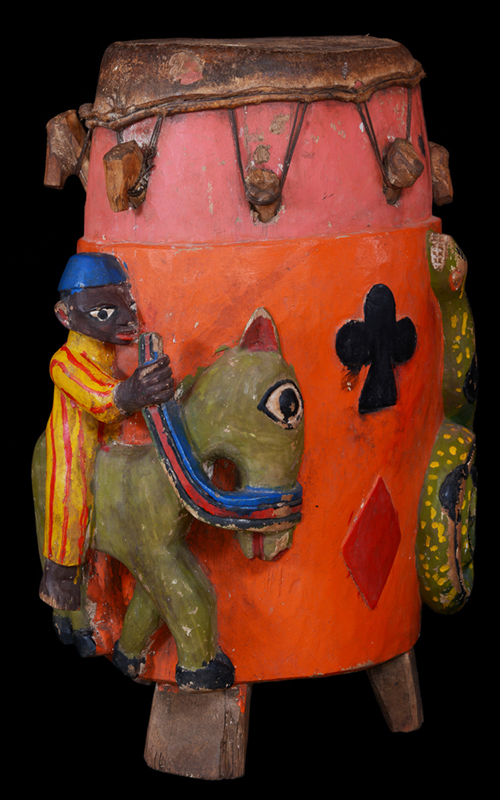
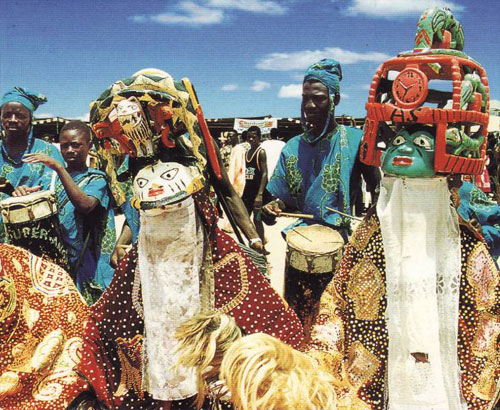
Gelede Drum (Yoruba, Benin, Togo or Nigeria)
Among the ceremonial traditions of the Yoruba, the annual Gèlèdè festival occupies a unique position as one of the most complex expressions of ritual performance, combining music, dance, masquerade, sculpture, poetry, and social commentary. The festival honors the creative and potentially dangerous spiritual powers of female ancestors and deities, collectively known as awon iya wa ("our mothers"). Through music and masked performances, the community seeks to establish harmony between the visible world and the supernatural forces believed to influence human life.
The present drum was almost certainly created for use within the context of the Gèlèdè tradition. Its brightly painted surface and elaborate sculptural decoration distinguish it from many other Yoruba ritual drums. Rather than emphasizing abstract ornamentation, the artist transformed the instrument into a narrative object by covering the drum body with figurative representations that immediately recall the theatrical character of Gèlèdè performances.
Particularly striking is the depiction of a rider mounted on a horse. Within Yoruba visual culture, horses have long been associated with prestige, political authority, wealth, and social status. Equestrian imagery frequently appears in Yoruba sculpture and ceremonial art, where it symbolizes power and public recognition. In the context of the Gèlèdè tradition, such figures often function as visual narratives that refer to social roles, historical events, or exemplary behavior within the community.
Equally remarkable are the painted geometric motifs, including symbols resembling playing-card emblems. Their presence suggests a comparatively recent artistic vocabulary influenced by cultural encounters and the incorporation of new visual elements into local artistic traditions. The Gèlèdè festival has historically demonstrated a remarkable capacity to integrate contemporary subjects, foreign influences, satire, and social criticism into ritual performance, allowing the tradition to remain dynamic while preserving its spiritual foundations.
From an organological perspective, the instrument belongs to the family of single-headed membranophones carved from a solid block of wood. The membrane is attached by wooden pegs and leather bindings, while the short legs elevate the resonator above the ground. Beyond its acoustic function, the drum demonstrates the close relationship between sculpture and music in Yoruba culture, where the visual appearance of an instrument may be as significant as its sound.
European and African scholars have repeatedly emphasized that the Gèlèdè tradition should not be understood merely as a masquerade or entertainment. Instead, it represents a sophisticated cultural institution through which communities negotiate social values, reinforce collective memory, honor female spiritual power, and preserve religious knowledge. Drumming and singing are therefore not secondary elements but essential components of the ceremony. Instruments such as the present example stand at the intersection of ritual practice, theatrical performance, and artistic expression, making them particularly valuable objects within ethnographic and museum collections.
"The annual Gelede festival honors the creative and dangerous powers of female ancestors and goddesses, known affectionately as 'our mothers.' The Gelede ceremony invokes and ensures the spiritual forces necessary for the well-being of the community. At the same time, the Gelede festival turns out to be a real show, entertainment, and fun for the people of the village. Drumming and singing are essential features of the ceremony."
Traditional description of the Yoruba Gèlèdè festival.
Babayemi, S. O.: Egungun among the Oyo Yoruba. African Arts, 1980.
Drewal, Henry John, Pemberton, John III, Abiodun, Rowland: Yoruba: Nine Centuries of African Art and Thought. New York, 1989.
Drewal, Henry John: Gelede: Art and Female Power among the Yoruba. Indiana University Press, 1983.
Kubik, Gerhard: Musikgeschichte in Bildern – Westafrika. Leipzig, 1989.
Lawal, Babatunde: The Gelede Spectacle: Art, Gender, and Social Harmony in Yoruba Culture.
Meyer, Andreas: Afrikanische Trommeln – West- und Zentralafrika. Staatliche Museen Preußischer Kulturbesitz, Berlin, 1997.
Thompson, Robert Farris: Black Gods and Kings: Yoruba Art at UCLA. Los Angeles, 1971.
Thieme, Darius: A Descriptive Catalogue of Yoruba Musical Instruments. Dissertation, Washington D.C., 1969.
Wieschhoff, Heinz: Die afrikanischen Trommeln und ihre außerafrikanischen Beziehungen. Stuttgart, 1933.