Holo / Pende Drum Democratic Republic of the Congo
Holo / Pende Drum (Kwango, Democratic Republic of the Congo)
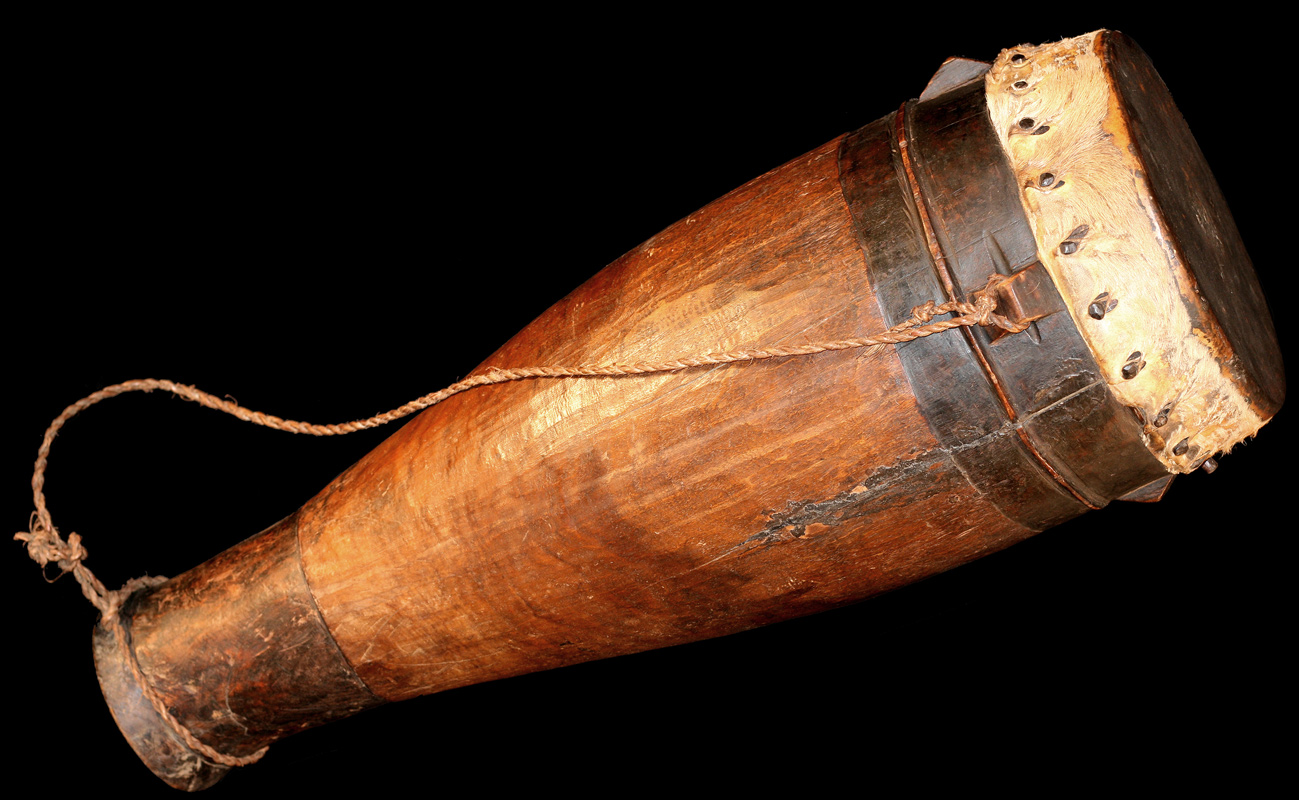
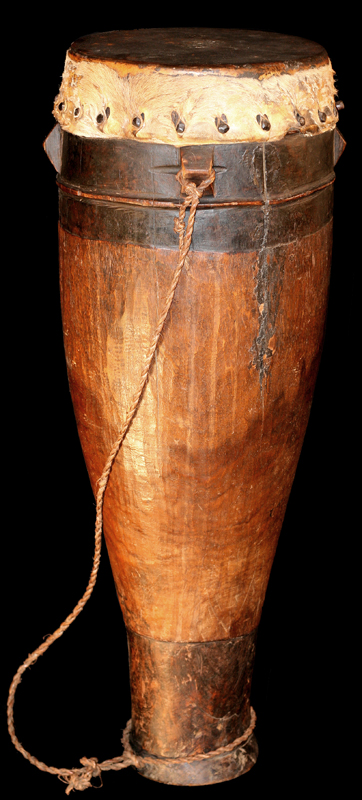
This tall single-headed membranophone comes from the Kwango region of the Democratic Republic of the Congo and is probably associated with the Holo or Pende. The exact ethnic attribution of the individual instrument cannot be established with certainty. Measuring approximately 94 cm in height, it is an unusually slender and elongated drum with a slightly conical wooden body, a broad upper section and a narrow lower end.
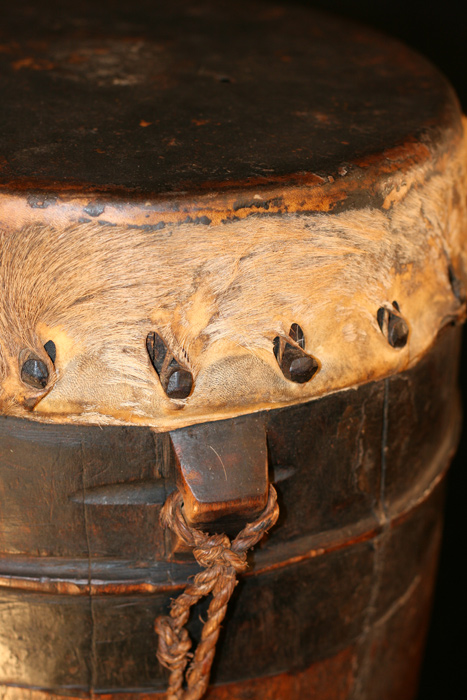
The drum is carved from a single piece of wood and covered with one animal-skin membrane. The skin is secured directly to the upper rim with numerous wooden pegs or nails. This method of attaching the membrane is characteristic of several drum traditions of the wider Kwango region and is also documented on Pende ngoma drums.
A distinctive feature of this drum is its integrated carrying system. Immediately below the membrane, a small loop has been carved from the wooden body. A cord is attached to this loop and runs vertically down the side of the drum before being secured around the lower part of the body. The arrangement allows the instrument to be suspended from the player's body during performance and is particularly suited to mobile musical and dance contexts.
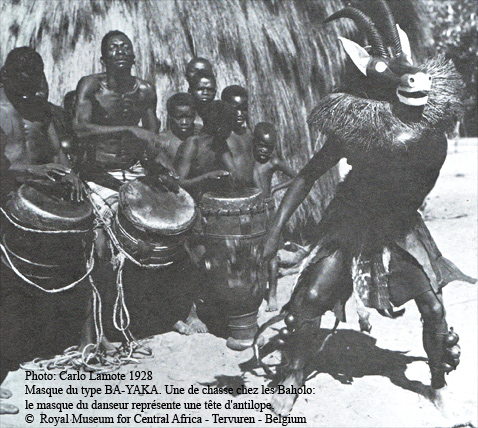
Drums played in the Kwango region are closely associated with dance, masquerade and initiation ceremonies. J.-N. Maquet documented specific Pende drum rhythms performed during initiation, including the kikuvu played during the nocturnal dance of the mungonge initiation society. His notation demonstrates that the percussion was organized into distinct rhythmic elements rather than functioning merely as an undifferentiated accompaniment.
Bibliography:Bastin, Marie-Louise: The Mwanangana Chokwe Chief and Art.
Bastin, Marie-Louise (1992): "Musical Instruments, Songs and Dances of the Chokwe (Dundo Region, Lunda District, Angola)." African Music: Journal of the International Library of African Music, Vol. 7, No. 2, pp. 23–44.
Boone, Olga (1951): Les tambours du Congo Belge et du Ruanda-Urundi. 2 vols. Tervuren: Annales du Musée du Congo Belge, Ethnographie 1.
Kubik, Gerhard (1989): Musikgeschichte in Bildern: Westafrika. Leipzig.
Maquet, J.-N. (1957): "Note sur les instruments de musique congolais." Sciences du Congo, nouvelle série, Tome VI, No. 4.
Maquet, J.-N. (1954): "Initiation à la musique congolaise." African Music, Vol. 1, No. 1, pp. 64–68.
Meyer, Andreas (1997): Afrikanische Trommeln – West- und Zentralafrika. Berlin: Staatliche Museen zu Berlin – Preußischer Kulturbesitz.
Schmidt-Wrenger, Barbara (1975): Muziek van de Tshokwe uit Zaire.
Wieschhoff, Heinz (1933): Die afrikanischen Trommeln und ihre außerafrikanischen Beziehungen. Stuttgart.