Africa
Igbo Slit Drum (Ufie or Ikoro, Igbo, Nigeria)
Igbo Slit Drum (Ufie or Ikoro, Igbo, Nigeria)
Among the Igbo of southeastern Nigeria, slit drums occupy a unique position within traditional systems of communication, political organization, ritual practice, and ceremonial life. Unlike many African percussion traditions in which instruments of different sizes are performed together as an ensemble, Igbo slit drums fulfill distinct and independent functions. Their significance extends far beyond music, since they traditionally served as instruments of public communication, symbols of authority, ritual objects, and visual expressions of social identity.
According to Igbo classification, slit drums are generally divided into three principal categories. The largest instruments are known as ufie or uhie, the medium-sized examples as ikolo or ikoro, and the smallest as ekwe. However, regional variations have led to considerable disagreement regarding the terminology. In Anambra State, the largest instrument is often called ikolo, while the medium-sized drum is known as ufie. In Imo State, the largest slit drum is commonly referred to as uhie, whereas the medium-sized example is called ikoro. Only the smallest slit drum, the ekwe, is identified by the same name throughout Igboland.
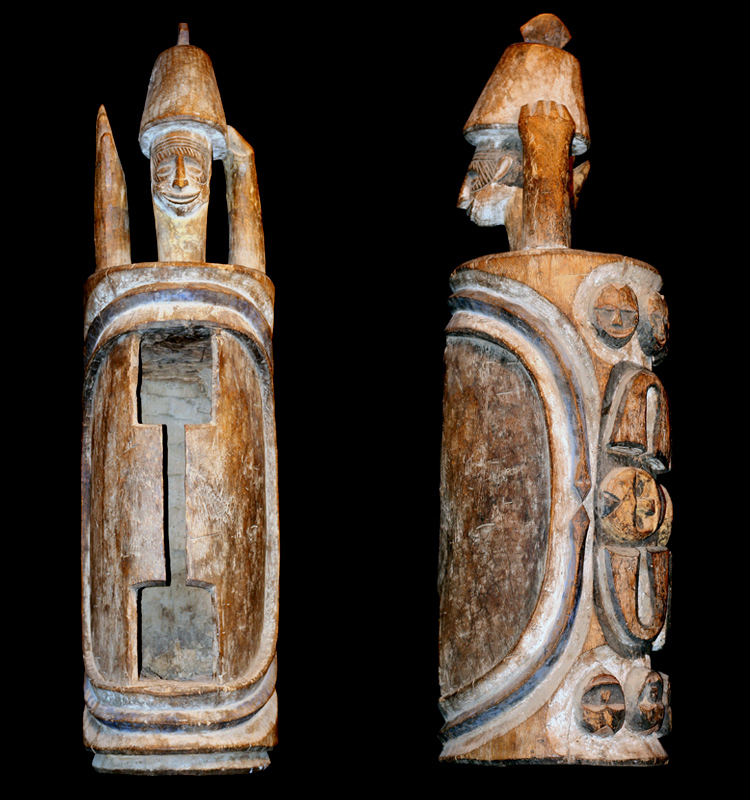
The slit drum illustrated here belongs to a category of instruments closely associated with political authority, heroic traditions, and ceremonial communication. Historically, such drums were used to transmit coded messages across considerable distances, announcing important events, summoning community members, communicating danger, and marking significant political or ritual occasions. Their powerful sound made them effective instruments for disseminating information throughout villages and neighboring settlements long before the introduction of modern communication systems.
Ethnographic research has demonstrated that the larger ikoro drums were closely associated with warfare, male authority, and heroic achievement. Unlike the smaller ekwe, which could be played by men, women, and children, the ikoro traditionally belonged to a more restricted social sphere. Other slit drums, including the vertically positioned ufie drums associated with titled Ozo chiefs, as well as instruments owned by market deities, fulfilled equally specialized ceremonial functions. The diversity of these instruments reflects the complexity of Igbo social organization and ritual life.
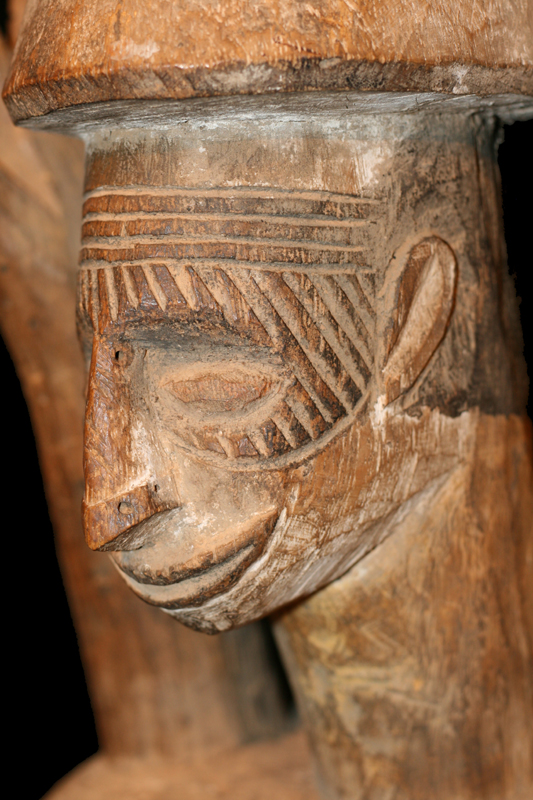
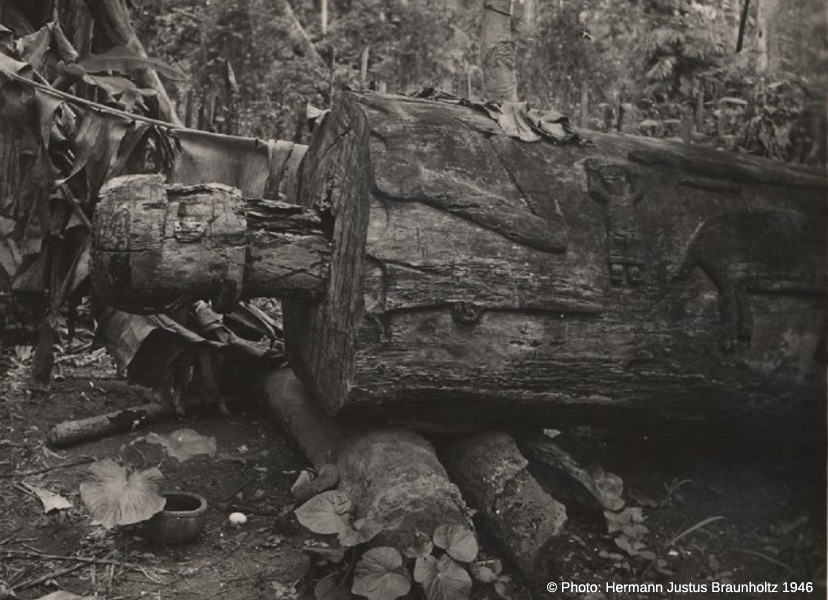
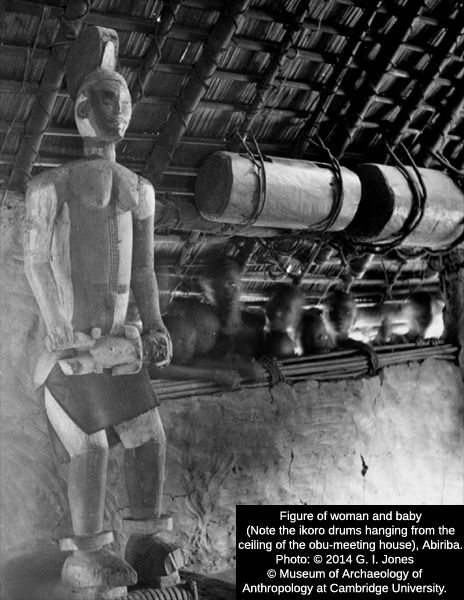
Particularly remarkable is the sculptural treatment of the present example. The drum body is crowned by a carved human figure, while the exterior is decorated with additional anthropomorphic motifs, geometric patterns, and symbolic ornaments. Comparable monumental slit drums documented in historical photographs frequently occupied prominent positions within ceremonial houses, public spaces, or shrines. The integration of sculpture and sound demonstrates the close relationship between music and visual art in Igbo culture, where instruments often function simultaneously as communication devices and symbolic representations of social authority.
"The igbo slit drums come in three sizes. Unlike other families of musical intruments, the three sizes of slit drums never play as a family, and musically they do not perform similar functions. The largest of the slit drums is known as ufie or uhie, the medium size as ikolo or ikoro, and the smallest as ekwe. There has always been disagreement on the names of the largest and medium slit drum. The Igbos of Anambra State call the largest slit drum ikolo and the medium one ufie. The Igbos of Imo State call their largest slit drum uhie and the medium one ikoro. The only agreement among all the Igbos is with the small slit drum which is called ekwe by all."
J. N. Lo-Bamijoko, Classification of Igbo Musical Instruments, Nigeria.
"Ekwe (slit drum), later elevated to ikoro, is a popular traditional musical instrument associated with Igbo communities of Southeast Nigeria. It was used by the communities for sending coded messages to people... Ikoro is a monumental slit drum associated with Igbo communities, east of the River Niger. There appears not to be any physical deference between the ikoro and the ekwe log drums in that they are both related in outward appearance as musical and information dissemination devices. However, while a simple ekwe is smaller and could be used by men, women and children, Ikoro is bigger, male oriented and closely associated with warfare and other heroic deeds. Also, there exist other forms of ekwe instrument which are neither used by women and children nor referred to as ikoro . The Ufie, a pair of vertically placed slit drums and played for the Ozo titled chiefs fall into this category, so also is the Ekwe Dike and other drums owned by market deities for sending messages to people the same way the ikoro is used among the communities that own them."
Chijioke Onuora, Ikoro Drums among the Igbo: Iconology and Design Symbols. Department of Fine and Applied Arts, University of Nigeria.
Lo-Bamijoko, J. N.: Classification of Igbo Musical Instruments, Nigeria.
Onuora, Chijioke: Ikoro Drums among the Igbo: Iconology and Design Symbols. Department of Fine and Applied Arts, University of Nigeria, pp. 19–22.
Aniakor, C. C. (1983): Ikoro: Heroic Drums of Igbo People. Paper presented during the Seminar on Igbo Life and Culture.
Berns, Marla C., Fardon, Richard, and Kasfir, Sidney Littlefield, eds. (2011): Central Nigeria Unmasked: Arts of the Benue River Valley.
Cole, Herbert M., and Aniakor, Chike C. (1984): Igbo Arts: Community and Cosmos.
Eyo, Ekpo (1977): Two Thousand Years of Nigerian Art.
Krieger, Kurt (1969): Westafrikanische Plastik. Berlin: Museum für Völkerkunde.
Okafor, R. C. (2005): Music in Nigerian Society. Enugu: New Generation Books.
Partridge, Charles (1905): Cross River Natives, Being Some Notes on the Primitive Pagans of Obubura Hill District, Southern Nigeria.