Africa
Kurkutu Hausa Drum Nigeria
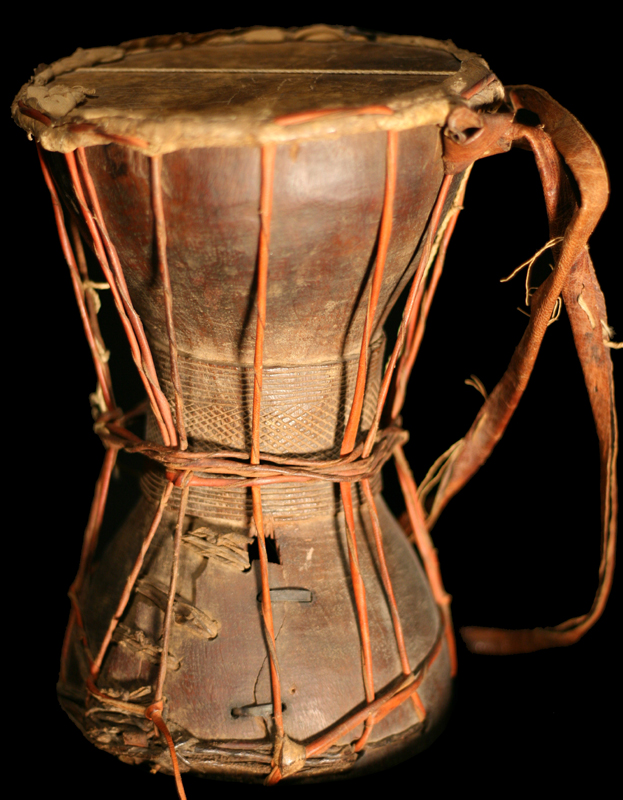
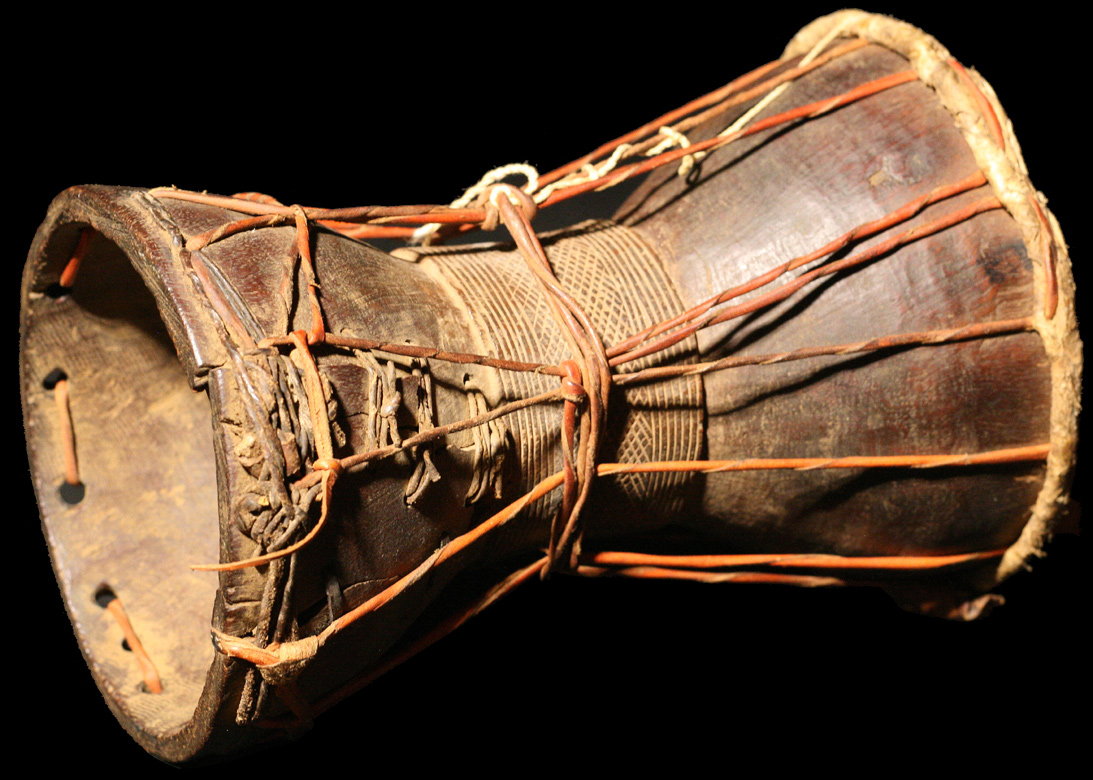
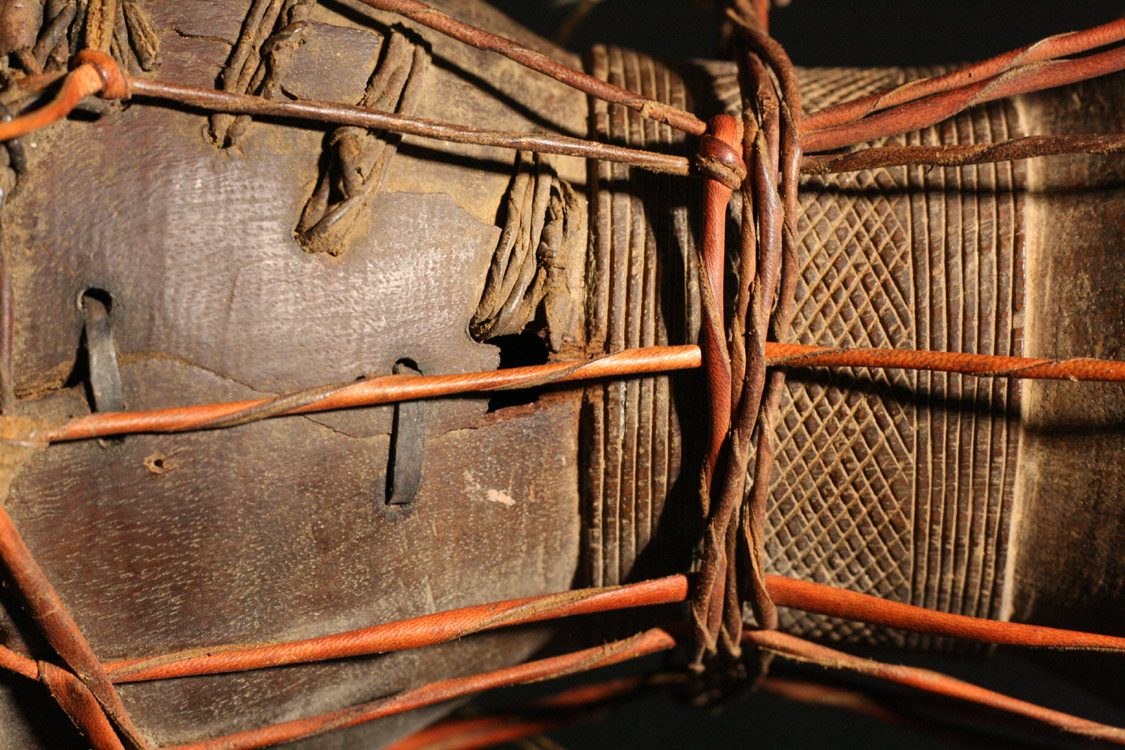
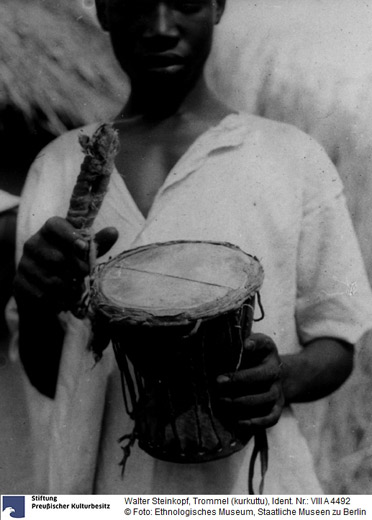
Kurkutu Drum (Hausa, Nigeria)
The Kurkutu is a small single-headed membranophone of the Hausa of northern Nigeria. Its compact body has an hourglass-like profile, with a broad upper section, a pronounced constriction in the middle, and a wider lower section. The drum is fitted with a single animal-skin membrane and a system of leather tension cords running vertically between the upper and lower parts of the body. A carrying strap allows the instrument to be suspended from the player's shoulder or neck.
The Kurkutu occupies a supporting position within Hausa drum ensembles. It is particularly associated with performances involving the kalangu, the well-known Hausa pressure drum whose two membranes can be tensioned during performance to produce changes in pitch. While the kalangu provides the characteristic melodic and speech-related phrases of the ensemble, the Kurkutu contributes a more regular rhythmic foundation. This complementary relationship illustrates the differentiated roles of individual drums within Hausa ensemble music.
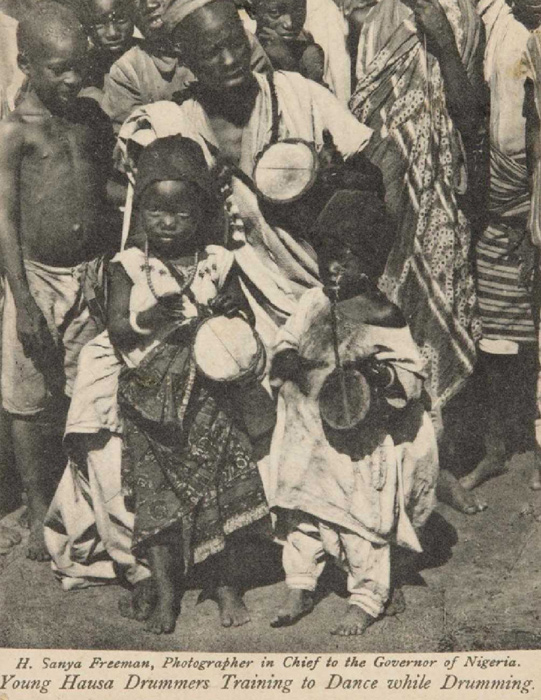
The instrument is played with two flexible leather beaters. Its construction permits the drum to be carried while playing, making it suitable for mobile performance and dance accompaniment. Historical and contemporary Hausa sources identify the Kurkutu as one of the smaller drums used by Hausa musicians, and related terminology such as kuntuku, kuntukuru and kanzagi occurs in descriptions of small Hausa drums. Regional terminology is not completely uniform, however, and the name Kurkutu should therefore be retained for the present instrument.
The Kurkutu is also important for understanding the organization of Hausa musical performance. Small supporting drums are often entrusted to younger or less senior members of a musical group, while more experienced musicians perform the principal parts on instruments such as the kalangu. The ensemble is consequently not based on a single dominant drum but on the interaction of contrasting rhythmic functions. The steady patterns of the supporting drum provide a framework within which the lead drummer can articulate more varied rhythmic phrases.
Bibliography:Meek, C. K. (1925): The Northern Tribes of Nigeria: An Ethnographical Account of the Northern Provinces of Nigeria, Together with a Report on the 1921 Decennial Census. 2 vols. London: Oxford University Press.
Gusau, S. M. (2016): Ƙamusun Kayan Kiɗan Hausa. Kano: Century Research and Publishing Company Limited.
Sallau, Bashir Aliyu (ed.) (2019): HAU 214: Hausa Trades and Crafts. National Open University of Nigeria, Faculty of Arts.
Ibrahim, M. S. (1983): Kowa Ya Sha Kiɗa. Lagos: Longman Nigeria PLC.
Salihu, A. A. (1985): "Kaɗe-kaɗen Hausawa da Bushe-bushe da Kayan Yin Su." Makon Hausa na 13. Kano: Ƙungiyar Hausa, Sashen Koyar da Harsunan Nijeriya, Jami'ar Bayero.
Zarruƙ, R. M., Kafin Hausa, A. A. & Alhassan, B. S. Y. (1987): Sabuwar Hanyar Nazarin Hausa Don Ƙananan Makarantun Sakandire, Littafi na Biyu. Ibadan: University Press PLC.
Meyer, Andreas (1997): Afrikanische Trommeln – West- und Zentralafrika. Berlin: Staatliche Museen zu Berlin – Preußischer Kulturbesitz.