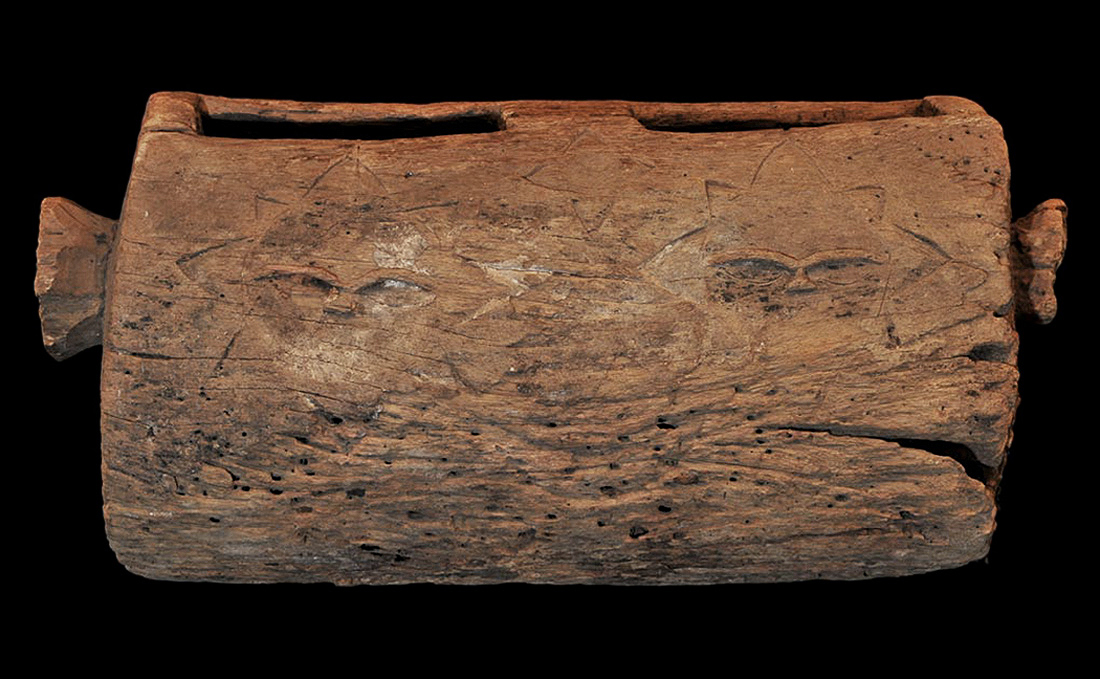
Slit Drum
Slit drums are among the important idiophones of Central African musical cultures. Unlike membranophones, they produce sound through the vibration of the wooden lips bordering the longitudinal opening. The two lips are normally made with different thicknesses, producing contrasting pitches when struck with wooden beaters. Jean-Sébastien Laurenty's extensive study of Central African slit drums documented a considerable variety of forms, including cylindrical, trapezoidal, zoomorphic and anthropomorphic examples, and examined the relationship between their construction and acoustic properties.
The difference in pitch between the two wooden lips gives the instrument an important musical and communicative potential. In Central African traditions where slit drums were used for signalling, the contrast between higher and lower tones could form the basis of coded rhythmic messages. Among peoples speaking tonal languages, skilled performers could reproduce characteristic elements of speech through combinations of the two pitches. Such systems were not identical everywhere, however, and the communicative use of slit drums varied according to local musical and social traditions.
Bibliography:
Laurenty, Jean-Sébastien (1968):
Les tambours à fente de l'Afrique centrale. Tervuren: Musée royal de l'Afrique centrale, 2 vols.
Carrington, John F. (1944):
The Drum Language of the Lokele Tribe.
Carrington, John F. (1949):
Talking Drums of Africa. London: Carey Kingsgate Press.
Kubik, Gerhard, Malamusi Moya Aliya & András Varsányi:
Afrikanische Musikinstrumente. Katalog und Nachdokumentation der Musikinstrumente aus Afrika südlich der Sahara in der Sammlung Musik des Münchner Stadtmuseums.
Brincard, Marie-Thérèse:
Sounding Forms – African Musical Instruments.
Royal Museum for Central Africa:
Music of Central Africa: Instruments from the Democratic Republic of the Congo. Tervuren.