Lele / Kuba drum / Democratic Republic of the Congo
Lele Drum (Lele / Kuba, Democratic Republic of the Congo)
The Lele people inhabit the Kasai River region of the present-day Democratic Republic of the Congo and share close historical and cultural ties with the neighboring Kuba kingdom. Both societies trace their origins to the legendary ancestor Woot and developed artistic traditions distinguished by highly sophisticated systems of visual symbolism. While Kuba textiles, cups, prestige objects, and masks have received considerable scholarly attention, the sculptural complexity of Lele musical instruments has often remained overlooked.
Drums occupied an important place within Lele and Kuba society and accompanied life-cycle rituals, funerary ceremonies, courtly events, and celebrations associated with political authority. Ethnographic accounts indicate that both men and women participated in musical performance and that drumming formed an essential component of ceremonial life. Rather than serving exclusively as musical accompaniment, drums functioned as instruments through which social relationships, historical memory, and political identity were expressed.
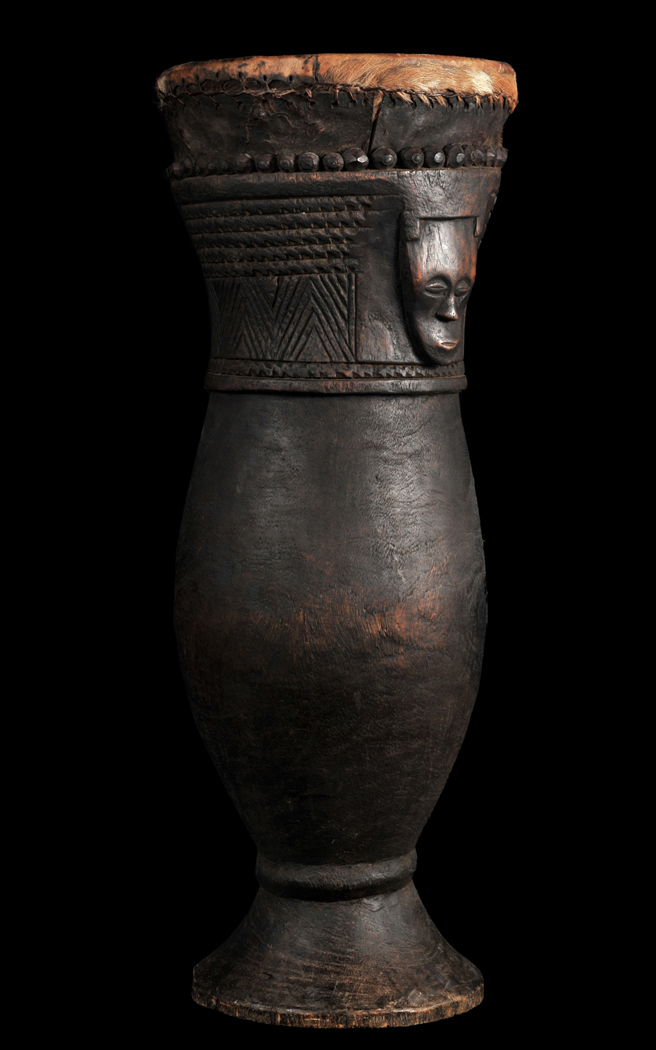
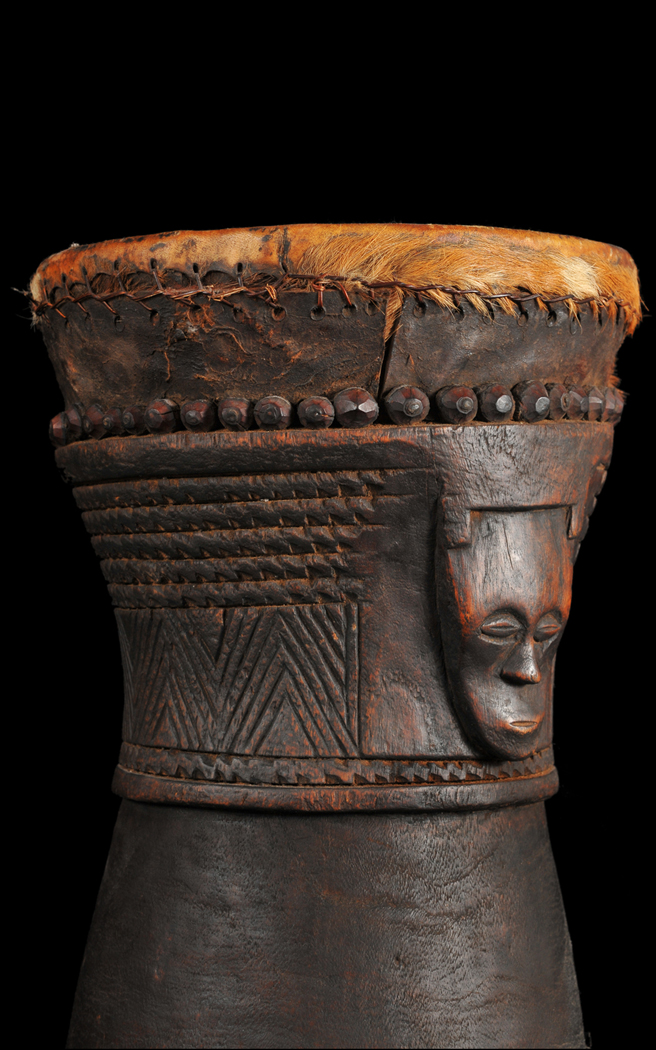
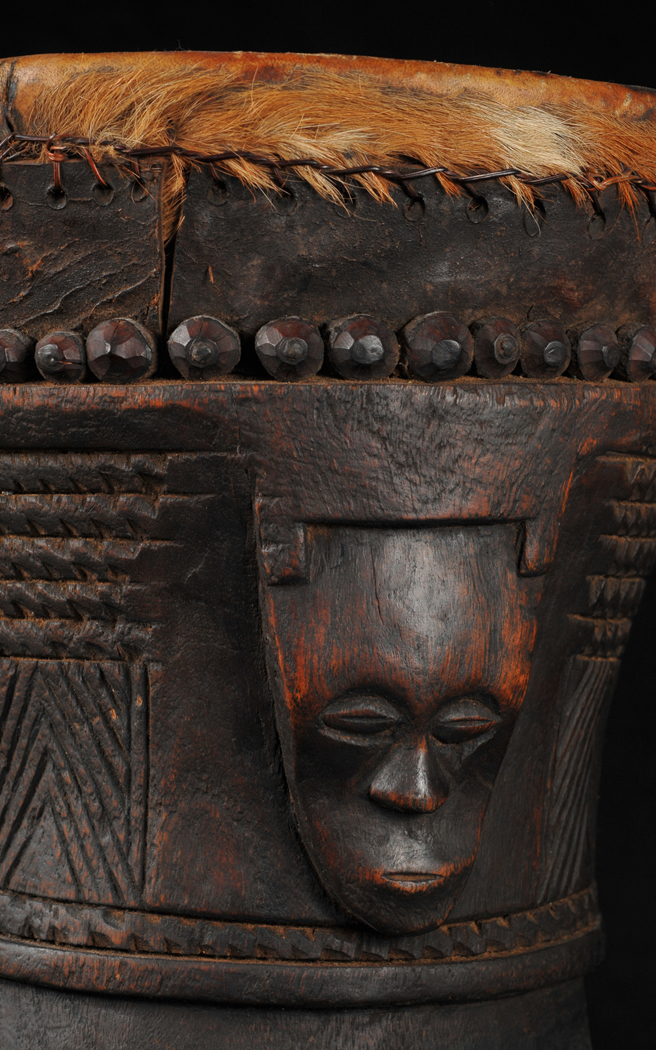
The present example is particularly remarkable because of its exceptional sculptural quality. The 73 cm high drum is carved from a single block of hardwood and combines several characteristic features of Kasai artistic traditions. The upper register is decorated with deeply incised geometric patterns composed of triangles, diagonal lines, and interlocking motifs that immediately recall the ornamental vocabulary found throughout Kuba and Lele visual culture. Beneath the drumhead, a mask-like face emerges from the surface of the instrument in high relief. The broad forehead, narrow eyes, elongated nose, small mouth, and tapering chin correspond closely to documented examples of Lele masks. The sculptor deliberately integrated the iconography of masquerade into the body of a musical instrument, thereby dissolving the conventional distinction between sculpture and sound-producing objects.
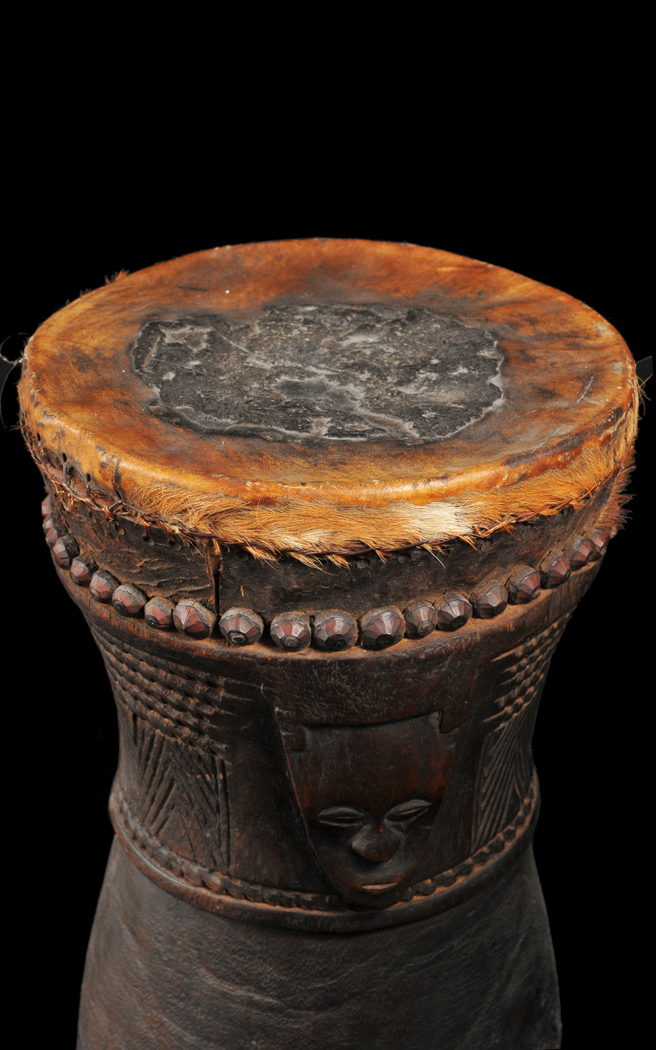
Particularly significant is the method used to attach the drumhead. The membrane is secured by means of the characteristic Kasai tensioning system found on many Kuba and Lele drums. A broad leather collar encircles the upper body of the instrument and is fixed with numerous wooden pegs. The membrane itself is sewn directly to this collar with plant fibers in a distinctive lacing pattern. The surviving animal hair along the circumference of the drumhead remains clearly visible and provides valuable evidence of traditional manufacturing techniques. A circular application of natural rubber at the center of the membrane increases the mass of the drumhead and probably contributed to a deeper and more resonant bass sound.
The symbolism of Lele drums has only recently attracted greater scholarly attention. Contemporary research suggests that the carved elements should not be interpreted as purely decorative motifs. Anthropomorphic figures, animals, and geometric designs constitute a visual language through which artists recorded historical events, social relationships, political structures, and cultural memory. The present drum exemplifies this concept particularly well. The mask-like face, the geometric ornamentation, and the characteristic Kasai construction together transform the instrument into a visual archive that preserves both artistic and cultural knowledge.
Within museum collections, Lele drums represent far more than ethnographic musical instruments. They are sculptural objects in which music, symbolism, craftsmanship, and social history converge. This example demonstrates how artistic expression within the Kasai region extended beyond masks and statuary into the realm of musical instruments, creating objects that simultaneously communicate through sound and through form.
References:
Boone, Olga: Les tambours du Congo Belge et du Ruanda-Urundi. 2 Vols. Tervuren: Annales du Musée du Congo Belge, 1951.
Brincard, Marie-Thérèse: Sounding Forms – African Musical Instruments. New York, 1989.
Chauvet, Stephen: Musique Nègre. Paris, 1929.
Cornet, Joseph: Art from Zaire. Brussels, 1975.
Dagan, Esther A.: Drums – The Heartbeat of Africa. Galerie Amrad, 1993.
Djedje, Jacqueline Cogdell: Turn Up the Volume! A Celebration of African Music. Fowler Museum of Cultural History, 1999.
Meyer, Andreas: Afrikanische Trommeln – West- und Zentralafrika. Staatliche Museen Preußischer Kulturbesitz, Berlin, 1997.
Wieschhoff, Heinz: Die afrikanischen Trommeln und ihre außerafrikanischen Beziehungen. Stuttgart, 1933.