DRUMS OF THE WORLD
lokele slit drum congo
Original quotation
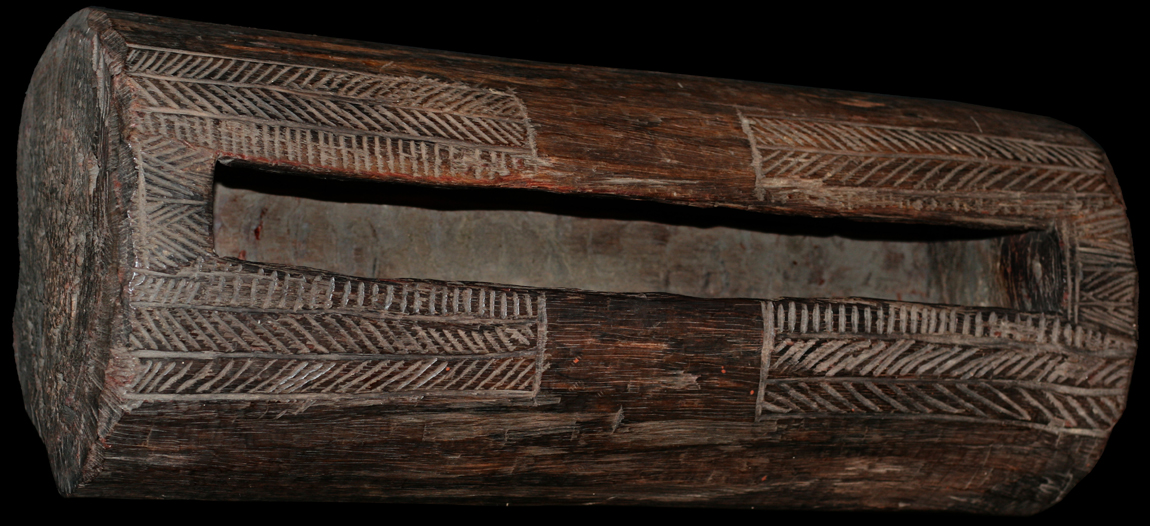
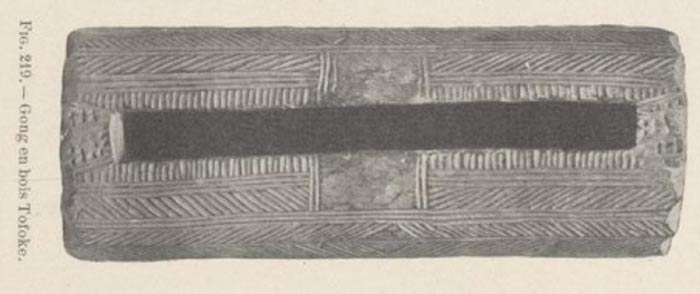
"The simplest kind of talking drum is the type used by the Lokele and surrounding tribes in the Stanleyville area of Belgian Congo. It is made from a solid log of reddish wood, hollowed out through a long narrow slit cut in the length of the log...
Wherever this type of drum occurs in Central Africa it is nearly always the same species of wood which is used to make it; namely Pterocarpus soyauxii.
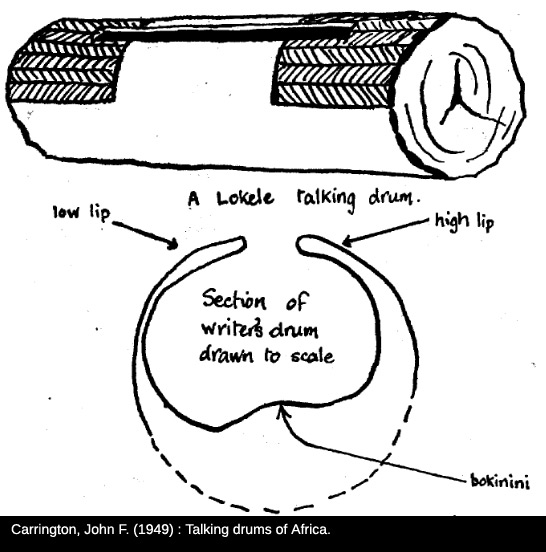
The drum maker first chisels out a narrow, longitudinal slit in the length of the cylindrical log. This slit is deepened until it penetrates about half-way into the log. The interior of the drum is then hollowed out on both sides of the primary slit.
The hollowing on the two sides of the primary slit is differential, one side becoming thinner-walled and hollower than the other. The hollower side when struck near the slit gives a lower note than the other side.
These two notes are distinguished as limiki lya otolome (voice of the male) and limiki lya otomali (voice of the female) for the high and low notes respectively.
In all drum-signalling communities every male member of the tribe has a drum name. This is given to him by his father, sometimes after a special ceremony such as the initiation ceremony.
The slit-drum is also used to beat out the dance rhythm. When the slit-drum helps to beat out the dance rhythm it does not 'talk' as for drum messages."
Excerpt from: Carrington, J. F.: Talking Drums of Africa. 1949.
Literature / References
Carrington, John F. (1949): Talking Drums of Africa. Carey Kingsgate Press.
Carrington, John F. (1944): The Drum Language of the Lokele Tribe.
Kubik, Gerhard; Malamusi, Moya Aliya; Varsányi, András: Afrikanische Musikinstrumente. Katalog und Nachdokumentation der Musikinstrumente aus Afrika südlich der Sahara in der Sammlung Musik des Münchner Stadtmuseums.
Laurenty, Jean-Sébastien (1968): Les tambours à fente de l'Afrique centrale. Musée royal de l'Afrique centrale, Tervuren. 2 volumes.
África. Música y Arte. (2009). With contributions by Marc Leo Félix, Madeleine Leclair, Louis Perrois and Bettina von Linting. Colección Helena Folch. Barcelona.
Brincard, Marie-Thérèse: Sounding Forms – African Musical Instruments.
"The simplest kind of talking drum is the type used by the Lokele and surrounding tribes in the Stanleyville area of Belgian Congo. It is made from a solid log of reddish wood, hollowed out through a long narrow slit cut in the length of the log...
Wherever this type of drum occurs in Central Africa it is nearly always the same species of wood which is used to make it; namely Pterocarpus soyauxii.
The drum maker first chisels out a narrow, longitudinal slit in the length of the cylindrical log. This slit is deepened until it penetrates about half-way into the log. The interior of the drum is then hollowed out on both sides of the primary slit.
The hollowing on the two sides of the primary slit is differential, one side becoming thinner-walled and hollower than the other. The hollower side when struck near the slit gives a lower note than the other side.
These two notes are distinguished as limiki lya otolome (voice of the male) and limiki lya otomali (voice of the female) for the high and low notes respectively.
In all drum-signalling communities every male member of the tribe has a drum name. This is given to him by his father, sometimes after a special ceremony such as the initiation ceremony.
The slit-drum is also used to beat out the dance rhythm. When the slit-drum helps to beat out the dance rhythm it does not 'talk' as for drum messages."
Excerpt from: Carrington, J. F.: Talking Drums of Africa. 1949.
Literature / References
Carrington, John F. (1949): Talking Drums of Africa. Carey Kingsgate Press.
Carrington, John F. (1944): The Drum Language of the Lokele Tribe.
Kubik, Gerhard; Malamusi, Moya Aliya; Varsányi, András: Afrikanische Musikinstrumente. Katalog und Nachdokumentation der Musikinstrumente aus Afrika südlich der Sahara in der Sammlung Musik des Münchner Stadtmuseums.
Laurenty, Jean-Sébastien (1968): Les tambours à fente de l'Afrique centrale. Musée royal de l'Afrique centrale, Tervuren. 2 volumes.
África. Música y Arte. (2009). With contributions by Marc Leo Félix, Madeleine Leclair, Louis Perrois and Bettina von Linting. Colección Helena Folch. Barcelona.
Brincard, Marie-Thérèse: Sounding Forms – African Musical Instruments.