Luba-Kasayi Drum, Democratic Republic of the Congo
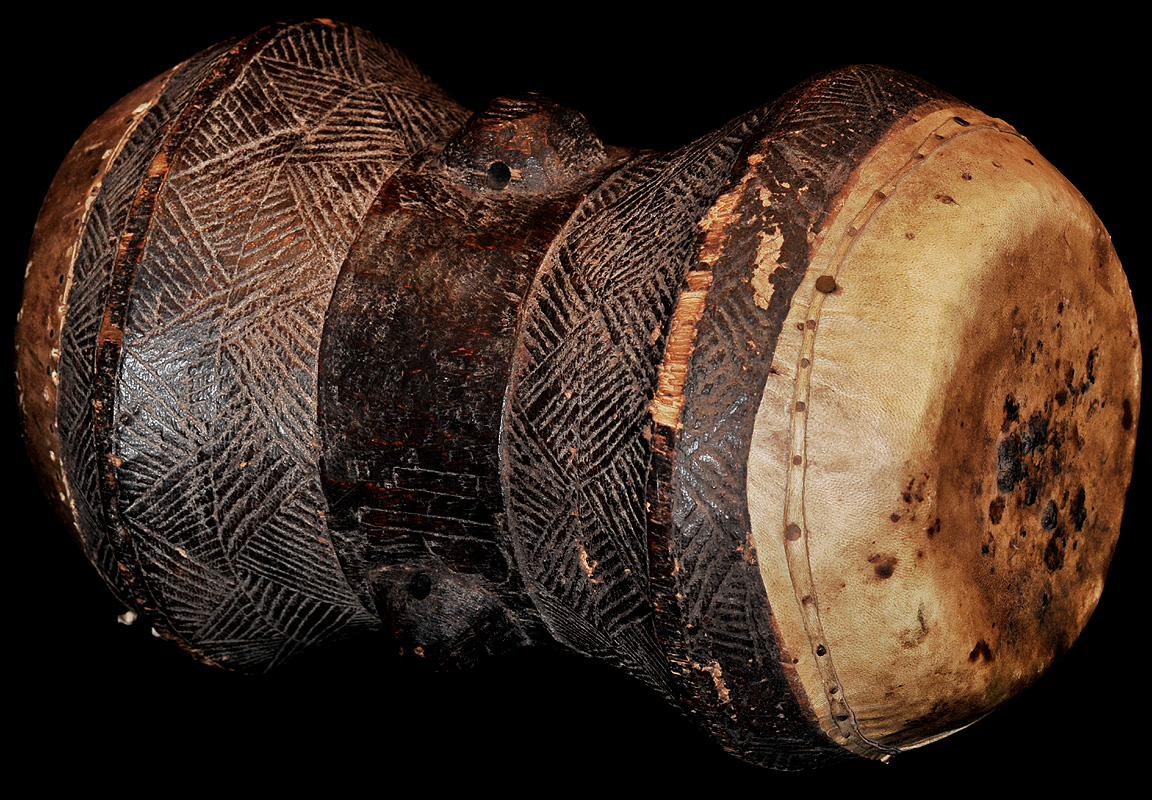
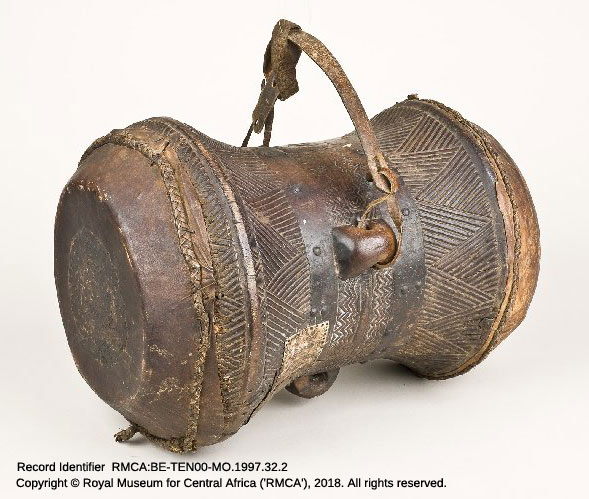
Nsambi Drum (Luba-Kasayi, Democratic Republic of the Congo)
This double-headed membranophone belongs to the musical traditions of the Luba-Kasayi of the Democratic Republic of the Congo. The drum shown here corresponds closely in form and construction to an example preserved in the collection of the Royal Museum for Central Africa in Tervuren, recorded under the inventory number BE-TEN00-MO.1997.32.2. The RMCA record does not assign a specific traditional name to the instrument. The designation nsambi is therefore based on terminology documented in the literature on Luba-Kasayi musical traditions rather than on the museum catalogue.
The instrument has a distinctive double-headed construction with a waisted wooden body and two membranes mounted at opposite ends. A central wooden projection and suspension device allow the drum to be carried or played horizontally in front of the performer. Its elaborately carved surface, with repeated geometric incised patterns, is characteristic of the visual treatment of the instrument and gives the drum an important sculptural as well as musical quality.
A closely related Luba drum form was documented by J.-S. Laurenty under the name ditumba dya munkubidi or tunshinkidi. Laurenty describes it as a two-headed drum with a wooden handle projecting from the centre of the body. A cord passed through this handle and around the drummer's neck, allowing the instrument to hang horizontally while the performer could strike either the right or the left membrane. Informants in Sungu Muluba stated that only highly skilled drummers were able to play this type of drum for accompanying dances.
The double-headed construction provides the performer with two playing surfaces and therefore a greater range of rhythmic and timbral possibilities than a single-headed drum. In Luba-Kasayi musical practice, drums could accompany dances, songs and important communal or ritual occasions. The nsambi is particularly associated in the literature with musical accompaniment, including the performance of kasàlà, the highly developed genre of Luba praise poetry and song.
The drum also reflects the close relationship between musical performance and visual expression in Luba art. Its carefully carved body, geometric surface decoration, pronounced central projection and double membranes combine practical requirements with a highly distinctive sculptural form. The surviving examples therefore document not only a musical instrument but also an important aspect of Luba-Kasayi artistic and material culture.
"Il s'agit du ditumba dya munkubidi ou tunshinkidi. C'est un tambour à deux peaux. Au milieu de la paroi saille une anse de bois par où passe une corde qui va entourer le cou du tambourineur. L'appareil pend donc horizontalement devant le joueur qui peut ainsi frapper à sa guise la peau droite et la peau gauche."
Laurenty, J.-S., "Les membranophones des Luba-Shankadi", African Music: Journal of the International Library of African Music, Vol. 5, No. 2, 1972, pp. 40–45.
Bibliography:
Laurenty, J.-S. (1972): "Les membranophones des Luba-Shankadi." African Music: Journal of the International Library of African Music, Vol. 5, No. 2, pp. 40–45.
Laurenty, J.-S. (1996): L'organologie du Zaïre. 3: Les membranophones. Tervuren: Musée royal de l'Afrique centrale.
Mufuta, Patrice (1970): Le Chant kasàlà des Lubà. Paris: Julliard.
Biaya, T. K. (1997): "Ngoma ya Madilu, the Mourning Drums: Luba-Kasayi Sacred Rituals, Dances and Celebrations." In: Esther A. Dagan (ed.), The Spirit's Dance in Africa: Evolution, Transformation and Continuity in Sub-Sahara, pp. 226–230. Westmount, Québec: Galerie Amrad African Arts Publications.
Boone, Olga (1951): Les tambours du Congo Belge et du Ruanda-Urundi. Tervuren: Annales du Musée du Congo Belge.
Gansemans, Jos (1978): Studies on Luba musical instruments and musical traditions.
Janzen, John M. (1992): Ngoma: Discourses of Healing in Central and Southern Africa. Berkeley: University of California Press.