Mbe Drum (Fang / Pangwe, Gabon)
Mbe Drum (Fang / Pangwe, Gabon)
Among the Fang peoples of present-day Gabon, Equatorial Guinea, southern Cameroon, and the Republic of the Congo, music formed an essential component of religious life, ancestor veneration, initiation, and communal ceremonies. Musical instruments were rarely conceived as purely acoustic devices. Instead, they occupied a cultural sphere in which sculpture, ritual practice, and sound were inseparably connected.
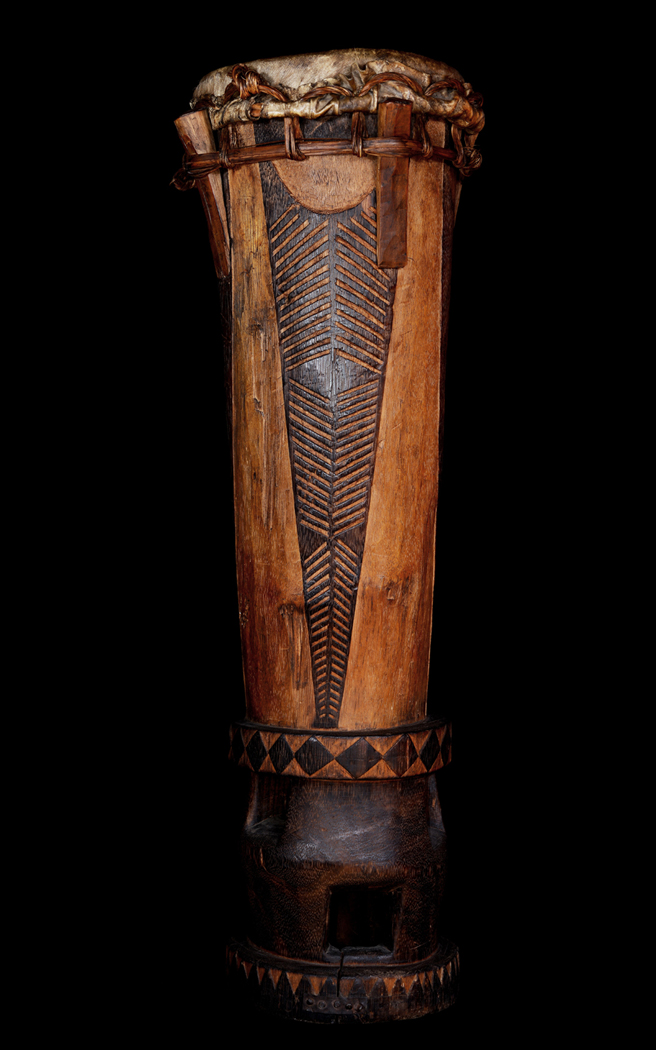
The present example belongs to a group of Fang drums known as mbe. These instruments are among the most distinctive drums of the Equatorial Forest region and are immediately recognizable through their elongated bodies and highly characteristic decorative programs. Ethnomusicologists have long noted the remarkable artistic quality of Fang musical instruments, whose surfaces frequently display carefully carved geometric motifs that are closely related to the decorative vocabulary found on masks, ancestor figures, weapons, and architectural elements.
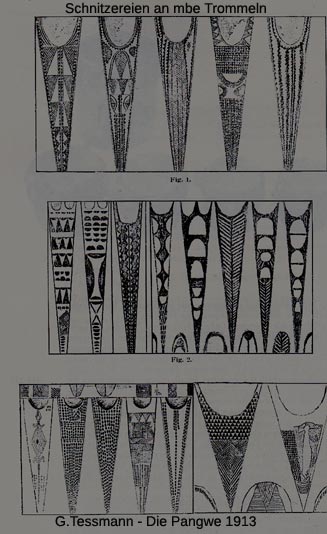
The most striking feature of this drum is the large, elongated triangular panel extending from the drumhead toward the center of the body. This motif is not an isolated decorative invention. Early ethnographic documentation by Günter Tessmann demonstrates that such tapering triangles constituted one of the most characteristic ornamental elements of Fang drums. Numerous variations of these designs were systematically illustrated and published as early as 1913, confirming that the decoration represented a recognized visual tradition rather than the personal style of an individual carver.
The lower section of the instrument is equally remarkable. The resonating chamber narrows toward the base and incorporates a rectangular sound aperture that influences the acoustic properties of the drum. The geometric ornamentation surrounding the opening creates a visual transition between the decorated upper section and the darker lower body. This combination of sculptural design and acoustic engineering reflects the sophisticated craftsmanship of Fang instrument makers.
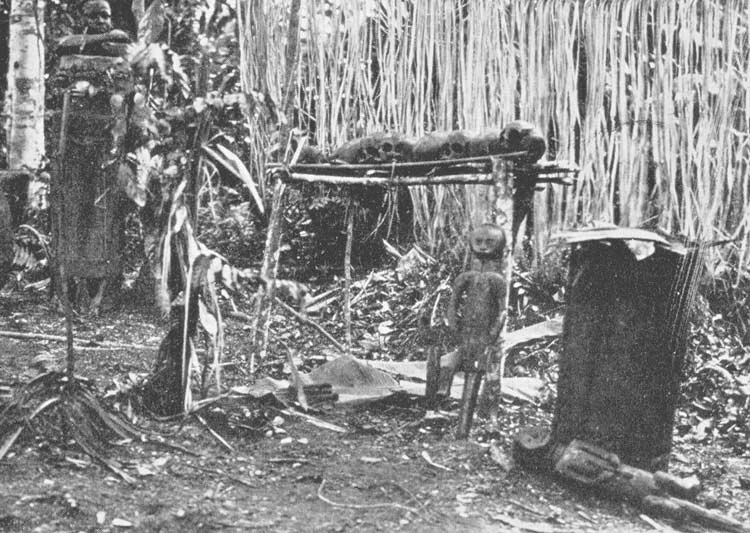
Historical sources indicate that drums such as this one were closely associated with ancestor rituals and initiation ceremonies. Among the Fang, ceremonies connected with the Byeri ancestor cult involved the ritual renewal of ancestral power through the veneration of sacred skulls preserved in reliquary containers. Music played a central role during these ceremonies and accompanied both public and restricted ritual performances. Ethnographic observations recorded during the early twentieth century further reveal that young initiates were required to approach the ritual ground alone and strike the ceremonial drum as a demonstration of courage and commitment to the ancestral cult.
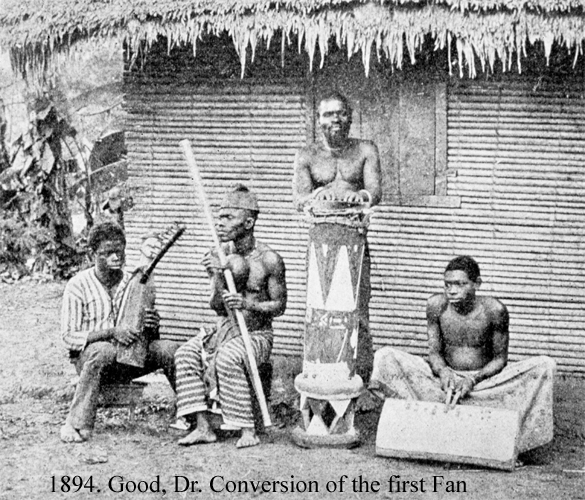
The historical photograph reproduced above provides exceptionally valuable documentation. It depicts a Fang musical ensemble in 1894 and shows a drum whose proportions, construction, and decorative program closely resemble the present example. Such visual evidence confirms that this instrument belongs to a well-established musical tradition that can be traced through both ethnographic literature and early photographic documentation.
Within museum collections, Fang drums occupy a unique position because they embody several artistic traditions simultaneously. They are musical instruments, sculptural objects, ritual implements, and historical documents. Their surfaces preserve a visual language that communicates social identity, ancestral continuity, and the cultural memory of one of Central Africa's most influential artistic traditions.
"The instruments of the Fan and their neighbours in Cameroon, Gabon and Equatorial Guinea are noted for their artistic, hand-crafted decorations. Commonly found on the sides of the instruments are carved, tapering triangles, these, too, being variously decorated. Instruments of this sort, known among the Fan as mbe, are traditionally played often in combination with slit-drums."
Andreas Meyer, Afrikanische Trommeln – West- und Zentralafrika. Berlin, 1997, p. 242.
"Die im Dorf befindlichen Ahnentonnen, es waren in diesem Falle vier, wurden auf dem Festplatz, auf dem sich die Männer versammelten und mehrere Trommeln und ein Xylophon bearbeiteten, am Ende vor der hinteren Wand aufgestellt. Einige Leute nahmen die Ahnenfiguren, gingen hinter die Wand und ließen sie von dort auf der Wand tanzen, genau wie bei uns im Kasperletheater. Die untere Hälfte der Figuren war mit einem Tuch verhüllt, so daß man nur ihren Oberkörper sah. Im Gänsemarsch rückten sie — mit Federhauben geschmückt — aus dem Hintergrunde heran, während die Bäume von den Männern geschüttelt wurden, und zogen vor die Wand, an der sie nun ihre possierlichen Bewegungen machten. Sie drehten sich, sie schüttelten sich, sie tanzten und sprangen herum, eine klammerte sich an eine Liane und griff verzweifelt an ihr herum, als ob sie verfolgt wäre und hinaufklettern wollte und es doch nicht konnte."
"In der folgenden Nacht müssen die Neulinge allein auf den Schädelplatz gehen und die dort aufgestellte Trommel schlagen, erstens als Beweis, daß sie auch wirklich dahin gegangen sind, und zweitens als Probe ihres Mutes, da die Uneingeweihten im Glauben sind, des Nachts hielten sich die Ahnenseelen in persona auf dem Platze auf."
Günter Tessmann, Die Pangwe. Völkerkundliche Monographie eines westafrikanischen Negerstammes. Ergebnisse der Lübecker Pangwe-Expedition 1907–1909.
Binet, Jacques. Sociétés de danse chez les Fang du Gabon. 1972.
Dagan, Esther A. Drums – The Heartbeat of Africa. Galerie Amrad, 1993.
Laburthe-Tolra, Philippe, and Christiane Falgayrettes-Leveau. Fang. Musée Dapper.
Meyer, Andreas. Afrikanische Trommeln – West- und Zentralafrika. Staatliche Museen Preußischer Kulturbesitz, Berlin, 1997.
Perrois, Louis. Ancestral Art of Gabon from the Collections of the Barbier-Mueller Museum. 1985.
Tessmann, Günter. Die Pangwe. Völkerkundliche Monographie eines westafrikanischen Negerstammes. Ergebnisse der Lübecker Pangwe-Expedition 1907–1909.