Africa
punu drum gabon
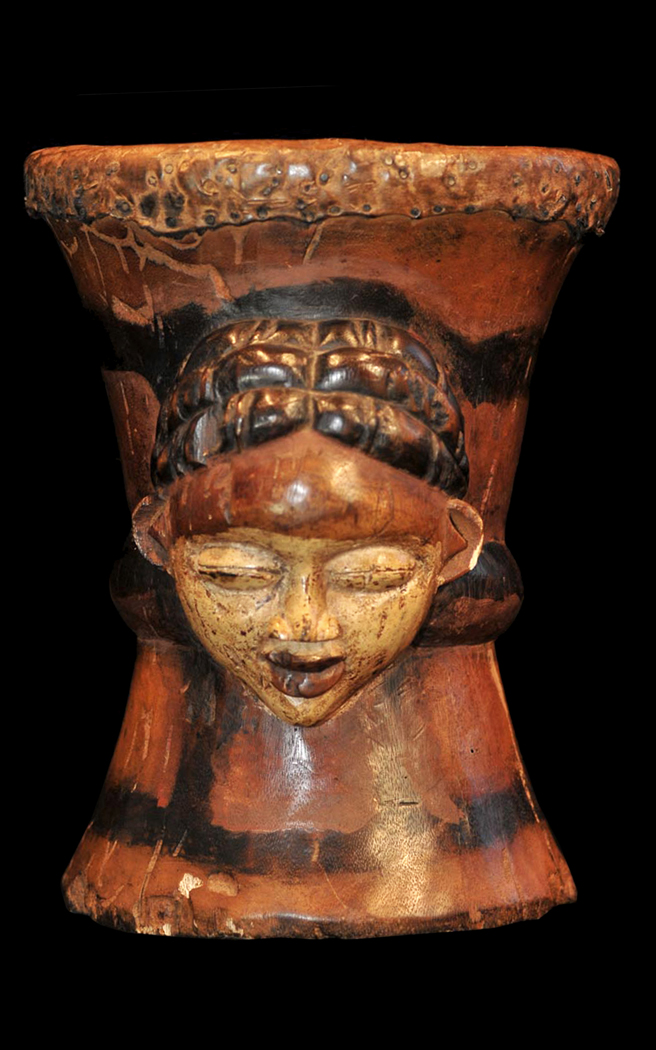
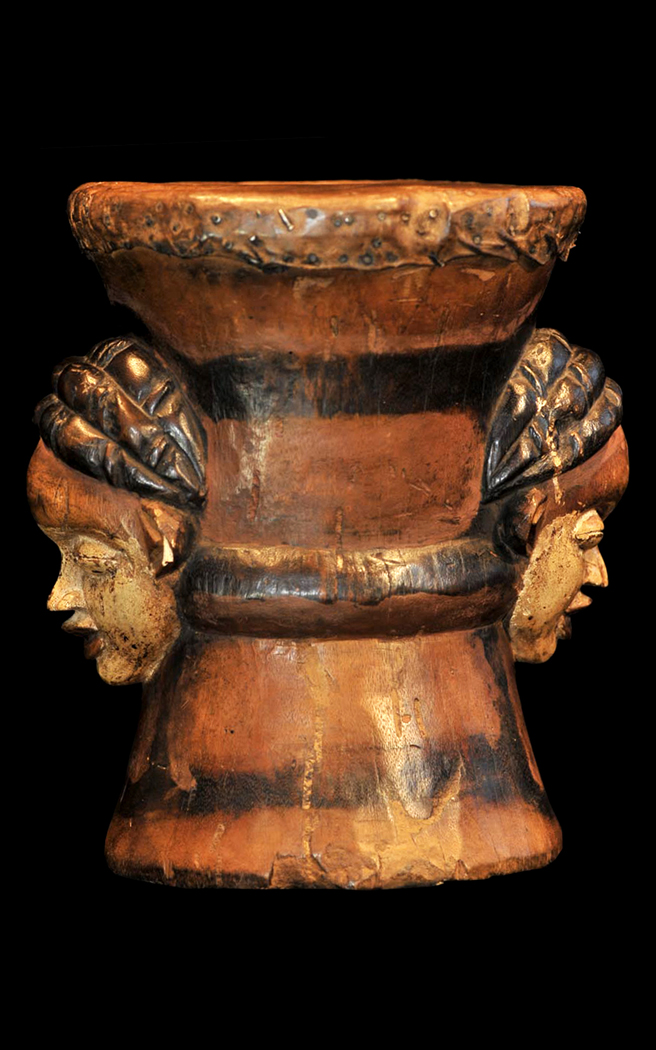
Punu Drum (Punu, Gabon)
Among the peoples of southern Gabon, the Punu are internationally recognized for one particular artistic tradition: the creation of elegant white-faced masks representing idealized female beauty. These masks, known as Mukudj, Mukuyi, or Okuyi, belong to a ceremonial world in which music, dance, masquerade, and ancestor veneration form an inseparable cultural system. Although Punu masks have been extensively documented in museums and academic publications, comparatively little attention has been paid to musical instruments that incorporate the same visual language.
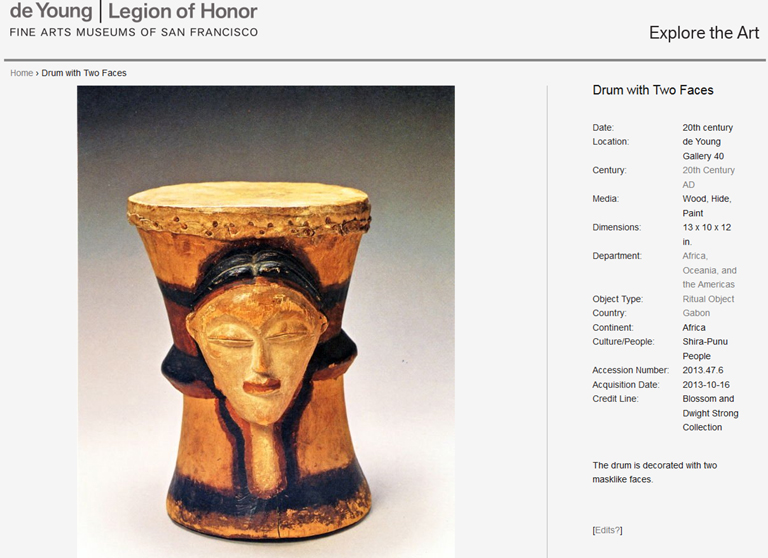
The present drum belongs to a small and highly distinctive group of Punu instruments characterized by the incorporation of carved human faces into the body of the instrument. According to Leon Siroto, all known examples appear to belong to a short series produced by a single, unidentified artist whose recognizable signature was the repeated use of mask-like female faces. This observation suggests the existence of a specialized workshop or an individual sculptor whose artistic vocabulary extended beyond masks and figures to include musical instruments.
The two carved faces decorating the present example clearly reflect the established aesthetic principles of Punu mask carving. The narrow, half-closed eyes, the carefully modeled lips, the elaborate coiffure, and the application of white pigment closely resemble the facial features of classical Mukudj masks. In Punu visual culture, white kaolin symbolizes the world of the ancestors rather than a specific gender. Nevertheless, the sculptural representation generally depicts an idealized female face associated with beauty, serenity, social refinement, and the continued presence of ancestral spirits.
Punu masquerades traditionally accompanied important communal events, particularly funeral ceremonies and celebrations honoring the dead. During these performances, masked dancers wearing elaborate fiber costumes and balancing on tall stilts moved rhythmically through the village while musicians provided the accompanying soundscape. Music was therefore not an independent artistic activity but an essential component of ritual performance that connected the visible world with the spiritual realm.
From an organological perspective, the instrument is a single-headed wooden membranophone carved from a single block of wood. The body expands toward the drumhead and narrows toward the base, creating an hourglass-like profile. Particularly remarkable is the transformation of the resonator into a sculptural composition. Instead of functioning solely as a sound-producing chamber, the body of the instrument simultaneously serves as a support for two opposing mask-like faces, creating a Janus-like arrangement that can be viewed from multiple directions.
This artistic synthesis demonstrates that traditional African musical instruments cannot be understood exclusively through their acoustic properties. The present drum occupies an intermediate position between sculpture, masquerade, and musical performance. Within museum collections, such objects provide important evidence that musical instruments frequently preserve the same symbolic language, artistic conventions, and ritual concepts that are more commonly associated with masks and statuary.
"Leon Siroto suggests that all drums of this type falls into a short series, apparently by one unknown carver whose signature was a maskoid or perhaps a rendering of a beautiful woman's face."
Leon Siroto, East of the Atlantic, West of the Congo. Art from Equatorial Africa. The Dwight and Blossom Strong Collection.
Siroto, Leon: East of the Atlantic, West of the Congo. Art from Equatorial Africa. The Dwight and Blossom Strong Collection. Fine Arts Museums of San Francisco, 1995.
Djedje, Jacqueline Cogdell: Turn Up the Volume! A Celebration of African Music. Fowler Museum of Cultural History, 1999.
LaGamma, Alisa: Art and Oracle. African Art and Rituals of Divination.
Perrois, Louis: Arts du Gabon. Paris, 1979.
Bassani, Ezio; Paudrat, Jean-Louis: The Power of Form. African Art from the Horstmann Collection. Milan, 2002.