DRUMS OF THE WORLD
Songye drum Democratic Republic of the Congo
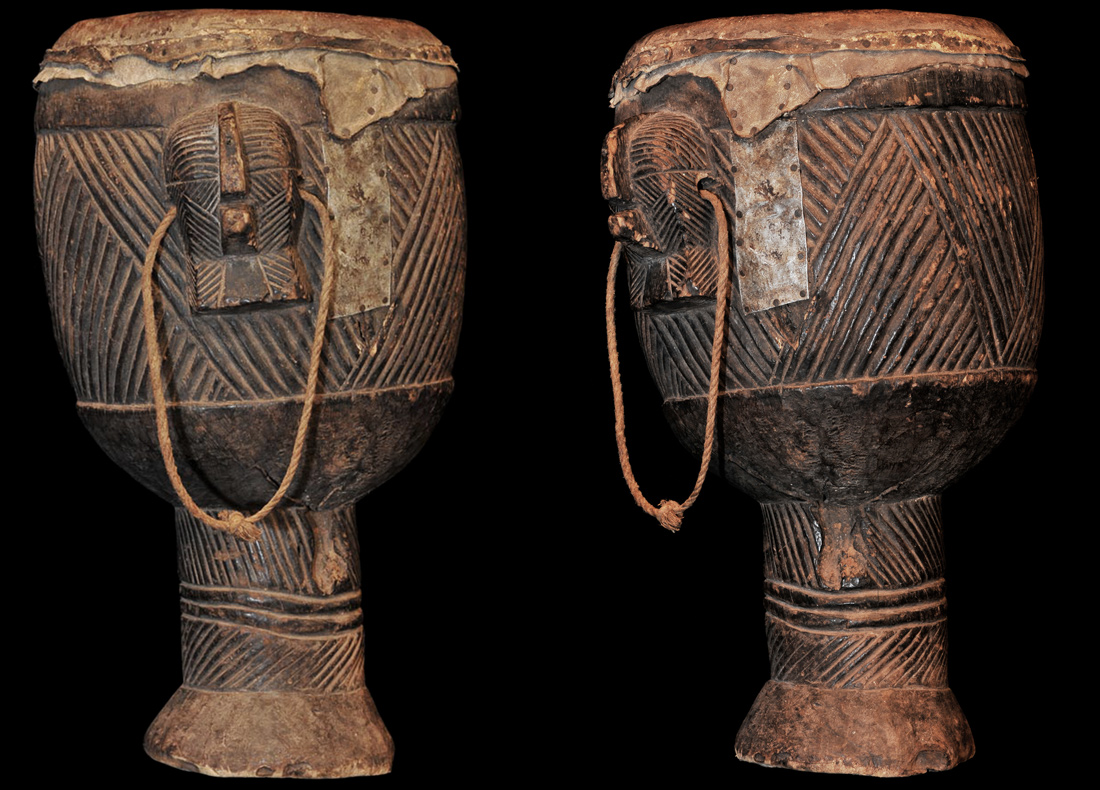
Songye ceremonial drum with Kifwebe mask / Trommel / Tambour – Democratic Republic of the Congo
The Songye (Basongye) of the south-central Democratic Republic of the Congo developed one of the most complex musical and ritual traditions in Central Africa. Music accompanied almost every important event in individual and communal life, including birth, initiation, chieftaincy, agricultural ceremonies, funerals, healing rituals, public celebrations, and the performances of secret associations.
This 52 cm high ceremonial drum is particularly remarkable because it combines two of the most characteristic artistic traditions of the Songye: musical performance and Kifwebe mask iconography. Rather than functioning as a simple percussion instrument, the drum unites sculpture, ritual symbolism, and music within a single object.
Cultural and Religious Context
Among the Songye, music was an indispensable social institution. Ceremonial specialists, professional musicians, singers, and dancers participated in events that structured both political and religious life. Musical performance was not considered entertainment in the modern sense but rather an essential social activity through which communities maintained cohesion and celebrated important transitions.
Particularly influential was the Bwadi bwa Kifwebe association, a powerful institution responsible for social control, initiation, political authority, conflict resolution, and the regulation of communal behavior. Kifwebe performances accompanied the installation and death of chiefs, initiation ceremonies, public works, judicial proceedings, and other important communal events. Music formed an integral component of these performances, and drums provided the rhythmic foundation for masked dances and ritual movement.
Historical Background
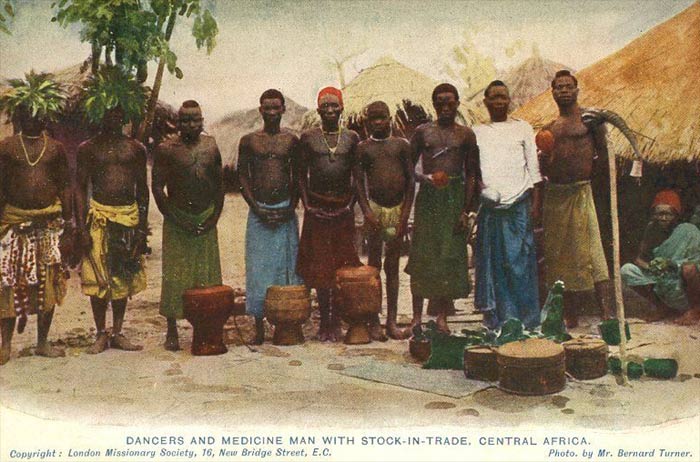
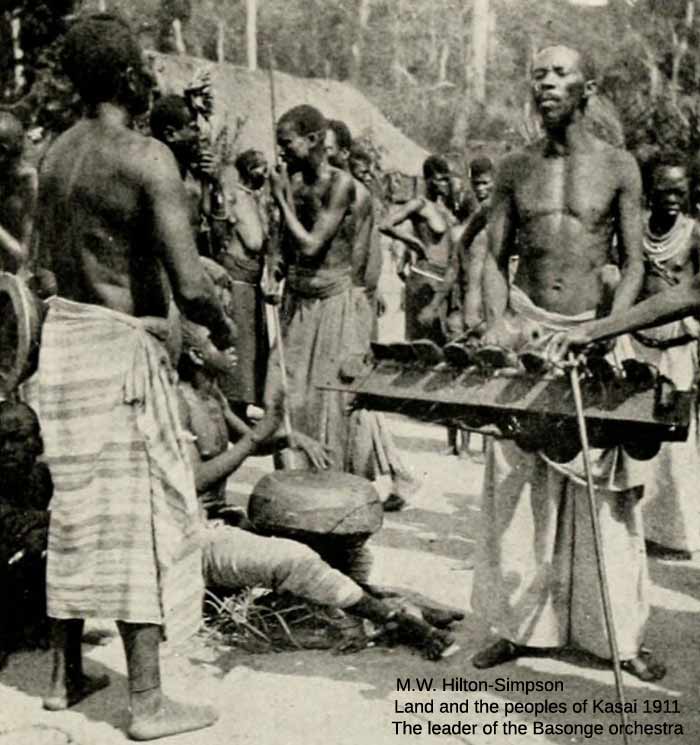
Historical photographs taken by M. W. Hilton-Simpson in the Kasai region in 1911 document the importance of music among the Basongye. These photographs show orchestras composed of lamellophones, rattles, drums, and singers, illustrating the central role of professional musicians within village life.
Ethnomusicologist Alan P. Merriam demonstrated that musicians occupied a unique position within Songye society. Although musicians were occasionally viewed as social outsiders, they nevertheless performed indispensable ceremonial functions. According to Merriam, village life without musicians was considered unimaginable.
The present drum probably belonged to this ceremonial environment. Its dimensions suggest that it was intended for active performance rather than for stationary use. With a height of 52 cm, it falls within the size range of portable ceremonial drums used during dances, processions, and public performances.
Organological Description
This instrument is a single-headed goblet-shaped membranophone carved from a single piece of hardwood. The drumhead is attached with wooden pegs and reinforced with additional strips of animal skin.
The body of the drum is entirely covered with finely carved diagonal grooves. Similar linear patterns also characterize Songye masks and sculptures, where incised lines often function as both decorative and symbolic elements.
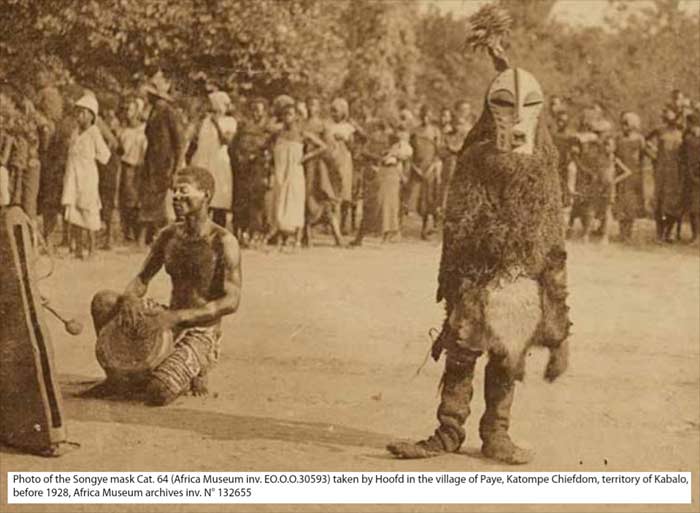
The most significant feature of the drum is the carved relief positioned directly beneath the drumhead. This carving clearly reproduces the characteristic facial features of a Kifwebe mask. The elongated face, the central ridge extending from the forehead to the nose, and the parallel striations correspond closely to documented examples of Songye Kifwebe masks.
The similarity between the carved relief and the historical mask represented in the accompanying photograph is unmistakable. The drum therefore establishes a direct visual relationship between the instrument and the ritual world of the Kifwebe association.
Art-Historical Significance
The artistic importance of this drum lies in the deliberate transfer of Kifwebe iconography from masks to a musical instrument. Jean Willy Mestach documented that Kifwebe imagery was not restricted to masks alone but also appeared on other Songye objects, including shields, plaques, and additional ceremonial objects. The present drum provides another example of this visual transmission within Songye artistic traditions.
The carved mask is almost certainly not a purely decorative element. Instead, it should be interpreted as a symbolic reference to the authority and ritual power of the Bwadi bwa Kifwebe association. The instrument thus became an extension of the same visual language expressed through masquerade, sculpture, and ceremonial performance.
From an art-historical perspective, this object demonstrates that the traditional separation between musical instruments and sculpture is often artificial. The drum should therefore be understood simultaneously as a membranophone, a ceremonial object, and a sculptural work of art.
The Songye (Basongye) of the south-central Democratic Republic of the Congo developed one of the most complex musical and ritual traditions in Central Africa. Music accompanied almost every important event in individual and communal life, including birth, initiation, chieftaincy, agricultural ceremonies, funerals, healing rituals, public celebrations, and the performances of secret associations.
This 52 cm high ceremonial drum is particularly remarkable because it combines two of the most characteristic artistic traditions of the Songye: musical performance and Kifwebe mask iconography. Rather than functioning as a simple percussion instrument, the drum unites sculpture, ritual symbolism, and music within a single object.
Cultural and Religious Context
Among the Songye, music was an indispensable social institution. Ceremonial specialists, professional musicians, singers, and dancers participated in events that structured both political and religious life. Musical performance was not considered entertainment in the modern sense but rather an essential social activity through which communities maintained cohesion and celebrated important transitions.
Particularly influential was the Bwadi bwa Kifwebe association, a powerful institution responsible for social control, initiation, political authority, conflict resolution, and the regulation of communal behavior. Kifwebe performances accompanied the installation and death of chiefs, initiation ceremonies, public works, judicial proceedings, and other important communal events. Music formed an integral component of these performances, and drums provided the rhythmic foundation for masked dances and ritual movement.
Historical Background
Historical photographs taken by M. W. Hilton-Simpson in the Kasai region in 1911 document the importance of music among the Basongye. These photographs show orchestras composed of lamellophones, rattles, drums, and singers, illustrating the central role of professional musicians within village life.
Ethnomusicologist Alan P. Merriam demonstrated that musicians occupied a unique position within Songye society. Although musicians were occasionally viewed as social outsiders, they nevertheless performed indispensable ceremonial functions. According to Merriam, village life without musicians was considered unimaginable.
The present drum probably belonged to this ceremonial environment. Its dimensions suggest that it was intended for active performance rather than for stationary use. With a height of 52 cm, it falls within the size range of portable ceremonial drums used during dances, processions, and public performances.
Organological Description
This instrument is a single-headed goblet-shaped membranophone carved from a single piece of hardwood. The drumhead is attached with wooden pegs and reinforced with additional strips of animal skin.
The body of the drum is entirely covered with finely carved diagonal grooves. Similar linear patterns also characterize Songye masks and sculptures, where incised lines often function as both decorative and symbolic elements.
The most significant feature of the drum is the carved relief positioned directly beneath the drumhead. This carving clearly reproduces the characteristic facial features of a Kifwebe mask. The elongated face, the central ridge extending from the forehead to the nose, and the parallel striations correspond closely to documented examples of Songye Kifwebe masks.
The similarity between the carved relief and the historical mask represented in the accompanying photograph is unmistakable. The drum therefore establishes a direct visual relationship between the instrument and the ritual world of the Kifwebe association.
Art-Historical Significance
The artistic importance of this drum lies in the deliberate transfer of Kifwebe iconography from masks to a musical instrument. Jean Willy Mestach documented that Kifwebe imagery was not restricted to masks alone but also appeared on other Songye objects, including shields, plaques, and additional ceremonial objects. The present drum provides another example of this visual transmission within Songye artistic traditions.
The carved mask is almost certainly not a purely decorative element. Instead, it should be interpreted as a symbolic reference to the authority and ritual power of the Bwadi bwa Kifwebe association. The instrument thus became an extension of the same visual language expressed through masquerade, sculpture, and ceremonial performance.
From an art-historical perspective, this object demonstrates that the traditional separation between musical instruments and sculpture is often artificial. The drum should therefore be understood simultaneously as a membranophone, a ceremonial object, and a sculptural work of art.
Original Quotations
"Society needs the services of musicians, for without music, normal life patterns simply cannot continue, at least as that society is currently construed by its members. Without the ngomba, the traveling professional, a major funeral cannot take place; without the ntunda, celebration of the village protector figure cannot operate on its regular lunar cycle. Birth, death, and most major events in between take place to the accompaniment of, or are celebrated through, music of one form or another."
"Though as an individual [the musician] may be scorned and stereotyped as a person of little consequence, his functions in the society make him essential. Indeed, nonmusicians, when proffered the suggestion that the village might be better off if these n'er-do-wells were banished from it, reacted with seriousness and, in some cases, almost horror. Life in a village without musicians is not to be considered, and people spoke of leaving the village were no musicians present. This reaction cannot be taken lightly, for the bonds of kinship and economics which tie an individual to his village are extremely difficult to break. Without musicians a village is incomplete. People want to be happy, and music-making is associated closely with happiness. (...) Musicians perform a variety of functions in village life which no one else can replace; life without them cannot be normal and is not to be contemplated seriously."
Alan P. Merriam : Basongye Musicians and Institutionalized Social Deviance.
Source: Yearbook of the International Folk Music Council, Vol. 11 (1979), pp. 1-26
Literature / References
Merriam, Alan P. Basongye Musicians and Institutionalized Social Deviance. Yearbook of the International Folk Music Council, Vol. 11, 1979, pp. 1–26.
Merriam, Alan P. Kifwebe and Other Masked and Unmasked Societies among the Basongye. Africa-Tervuren, Vol. 24, No. 3, 1978.
Hilton-Simpson, M. W. Land and the Peoples of the Kasai. London, 1911.
Mestach, Jean Willy. Etudes Songye: Songye Studies – Form and Symbolism. An Analytical Essay. Munich, 1985.
Felix, Marc Leo. Beauty and the Beasts: Kifwebe and Animal Masks of the Songye, Luba and Related Peoples. Tribal Arts S.P.R.I., 2003.
Hersak, Dunja. Songye: Masks and Figure Sculpture.
Volper, Julien. Under the Influence of the Songye. Annales des Arts Africains, 2012.
Neyt, François. Songye: The Formidable Statuary of Central Africa.
Neyt, François. Kifwebe: A Century of Songye and Luba Masks. 2019.
"Society needs the services of musicians, for without music, normal life patterns simply cannot continue, at least as that society is currently construed by its members. Without the ngomba, the traveling professional, a major funeral cannot take place; without the ntunda, celebration of the village protector figure cannot operate on its regular lunar cycle. Birth, death, and most major events in between take place to the accompaniment of, or are celebrated through, music of one form or another."
"Though as an individual [the musician] may be scorned and stereotyped as a person of little consequence, his functions in the society make him essential. Indeed, nonmusicians, when proffered the suggestion that the village might be better off if these n'er-do-wells were banished from it, reacted with seriousness and, in some cases, almost horror. Life in a village without musicians is not to be considered, and people spoke of leaving the village were no musicians present. This reaction cannot be taken lightly, for the bonds of kinship and economics which tie an individual to his village are extremely difficult to break. Without musicians a village is incomplete. People want to be happy, and music-making is associated closely with happiness. (...) Musicians perform a variety of functions in village life which no one else can replace; life without them cannot be normal and is not to be contemplated seriously."
Alan P. Merriam : Basongye Musicians and Institutionalized Social Deviance.
Source: Yearbook of the International Folk Music Council, Vol. 11 (1979), pp. 1-26
Literature / References
Merriam, Alan P. Basongye Musicians and Institutionalized Social Deviance. Yearbook of the International Folk Music Council, Vol. 11, 1979, pp. 1–26.
Merriam, Alan P. Kifwebe and Other Masked and Unmasked Societies among the Basongye. Africa-Tervuren, Vol. 24, No. 3, 1978.
Hilton-Simpson, M. W. Land and the Peoples of the Kasai. London, 1911.
Mestach, Jean Willy. Etudes Songye: Songye Studies – Form and Symbolism. An Analytical Essay. Munich, 1985.
Felix, Marc Leo. Beauty and the Beasts: Kifwebe and Animal Masks of the Songye, Luba and Related Peoples. Tribal Arts S.P.R.I., 2003.
Hersak, Dunja. Songye: Masks and Figure Sculpture.
Volper, Julien. Under the Influence of the Songye. Annales des Arts Africains, 2012.
Neyt, François. Songye: The Formidable Statuary of Central Africa.
Neyt, François. Kifwebe: A Century of Songye and Luba Masks. 2019.