Africa
Tabwa Drum | Lake Tanganyika Region
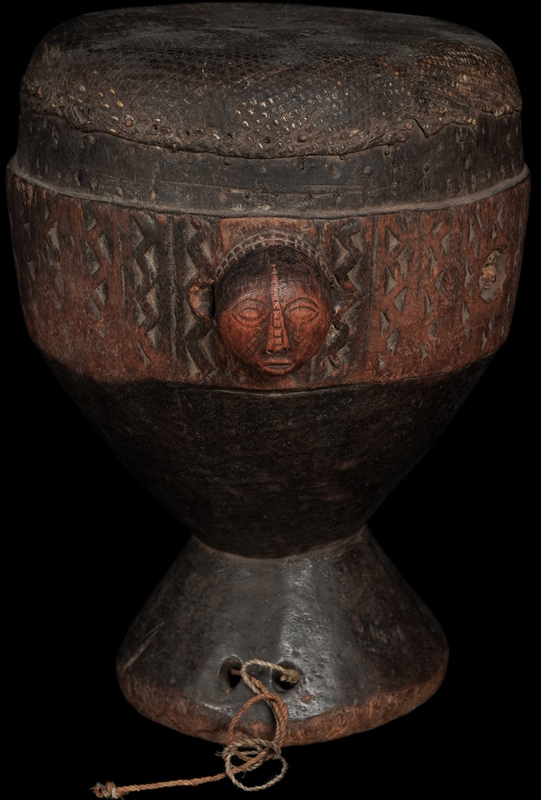
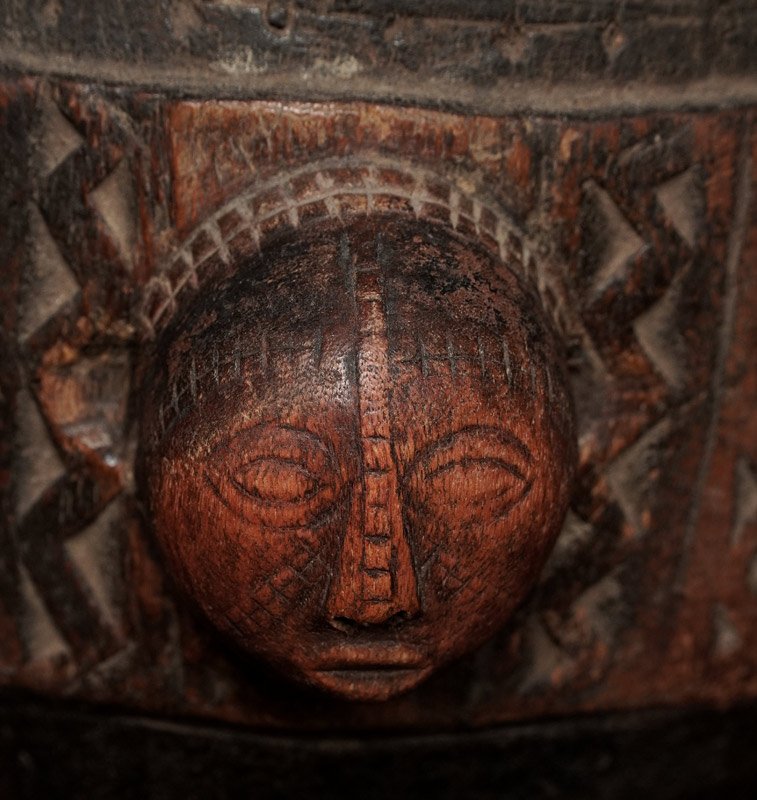
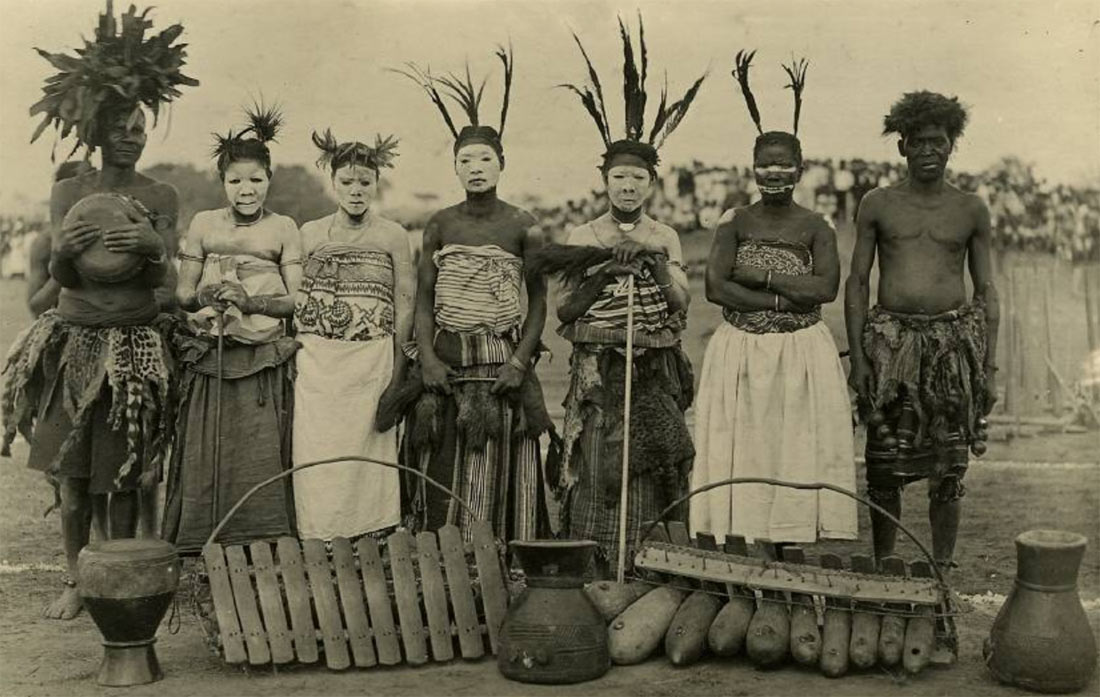
Tabwa Drum (Lake Tanganyika Region, Democratic Republic of the Congo)
Music plays an important role in the cultural traditions of the Tabwa, whose communities inhabit the region around Lake Tanganyika in Central Africa. Drumming is associated with communal gatherings, dance and ceremonial occasions, where rhythmic patterns interact with movement and song. The musical traditions of the region also reflect historical cultural exchanges among neighbouring peoples, including the Tabwa, Luba and Songye.
A particularly significant acoustic feature of certain drums from the Lake Tanganyika region is the mirliton, a secondary vibrating membrane incorporated into an opening in the wooden body. Traditionally made from a delicate natural membrane, sometimes derived from a spider's cocoon, it responds to the air pressure generated when the main drumhead is struck. Its sympathetic vibration produces a characteristic buzzing resonance, enriching the drum's timbre beyond a simple percussive tone.
The mirliton represents an ingenious acoustic principle found in several Central African musical traditions. Rather than being considered an unwanted noise, the buzzing resonance forms an integral part of the instrument's sound. It adds texture and complexity to the tone and can enhance the drum's audibility in musical settings involving dance and larger ensembles.
The carved human face is an equally important feature of the instrument. Rather than being applied as a separate element, it emerges from the wooden body itself, demonstrating the integration of sculpture and instrument-making. The combination of anthropomorphic carving, geometric ornament and carefully selected natural materials illustrates how Central African drums can be understood not merely as sound-producing objects, but also as works of sculptural expression and material culture.
Bibliography:Maurer, Evan M.; Roberts, Allen F. (1985): Tabwa – The Rising of a New Moon: A Century of Tabwa Art. University of Michigan Museum of Art.
Boone, Olga (1951): Les tambours du Congo Belge et du Ruanda-Urundi. 2 vols. Tervuren: Annales du Musée du Congo Belge; Ethnographie 1.
Laurenty, Jean-Sébastien (1996): L'Organologie du Zaïre. Tome III. Les membranophones. Tervuren: Musée royal de l'Afrique centrale.
Dagan, Esther A. (ed.) (1993): Drums – The Heartbeat of Africa. Galerie Amrad African Art Publications.
Thomson, Joseph (1891): To the Central African Lakes and Back. London.