DRUMS OF THE WORLD
Tikar drum Cameroon
Original quotations
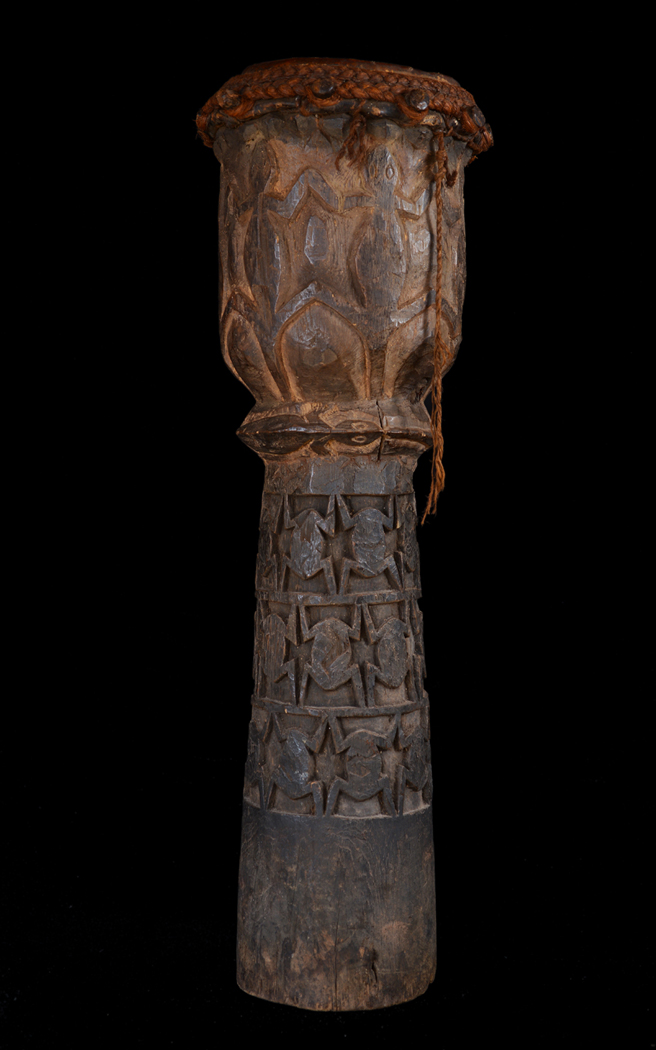
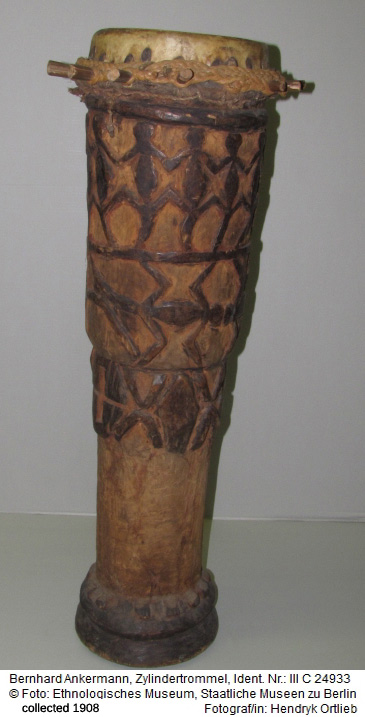
"The ornamented ceremonial drums of the grassland area have bodies in the shape of goblets, barrels or cylinders."
"The skins are secured to the shells with nails. The carved drums are always played with the hands."
"They are used at ritual ceremonies, chiefly at burials and memorial celebrations."
"Drums carved with anthropomorphic or zoomorphic figures always belong to the whole community; they are never the property of individuals."
"Frogs symbolise fertility and growth."
"Mit Tierfiguren beschnitzte Trommeln befanden sich nicht im Besitz von Privatpersonen. Sie gehörten zum Inventar des Palastes oder waren im Besitz von Geheimgesellschaften. Sie werden hauptsächlich bei Begräbnissen und im Ahnenkult verwendet. Allerdings wurden sie früher auch bei verschiedenen Jahresfesten benutzt, die heute jedoch nur noch bei sehr wenigen Bevölkerungsgruppen gefeiert werden."
Literature / References
Ankermann, B.: Die afrikanischen Musikinstrumente.
Bebey, Francis: African Music: A People's Art. New York: Lawrence Hill, 1975.
Brincard, M. T.: Sounding Forms – African Musical Instruments. 1989.
Dagan, Esther A.: Drums – The Heartbeat of Africa. Galerie Amrad, 1993.
Kubik, Gerhard: Musikgeschichte in Bildern – Westafrika. Leipzig, 1989.
Meyer, Andreas: Afrikanische Trommeln – West- und Zentralafrika. Staatliche Museen Preußischer Kulturbesitz, Berlin, 1997.
Wieschhoff, Heinz: Die afrikanischen Trommeln und ihre außerafrikanischen Beziehungen. Stuttgart, 1933.
"The ornamented ceremonial drums of the grassland area have bodies in the shape of goblets, barrels or cylinders."
"The skins are secured to the shells with nails. The carved drums are always played with the hands."
"They are used at ritual ceremonies, chiefly at burials and memorial celebrations."
"Drums carved with anthropomorphic or zoomorphic figures always belong to the whole community; they are never the property of individuals."
"Frogs symbolise fertility and growth."
"Mit Tierfiguren beschnitzte Trommeln befanden sich nicht im Besitz von Privatpersonen. Sie gehörten zum Inventar des Palastes oder waren im Besitz von Geheimgesellschaften. Sie werden hauptsächlich bei Begräbnissen und im Ahnenkult verwendet. Allerdings wurden sie früher auch bei verschiedenen Jahresfesten benutzt, die heute jedoch nur noch bei sehr wenigen Bevölkerungsgruppen gefeiert werden."
Literature / References
Ankermann, B.: Die afrikanischen Musikinstrumente.
Bebey, Francis: African Music: A People's Art. New York: Lawrence Hill, 1975.
Brincard, M. T.: Sounding Forms – African Musical Instruments. 1989.
Dagan, Esther A.: Drums – The Heartbeat of Africa. Galerie Amrad, 1993.
Kubik, Gerhard: Musikgeschichte in Bildern – Westafrika. Leipzig, 1989.
Meyer, Andreas: Afrikanische Trommeln – West- und Zentralafrika. Staatliche Museen Preußischer Kulturbesitz, Berlin, 1997.
Wieschhoff, Heinz: Die afrikanischen Trommeln und ihre außerafrikanischen Beziehungen. Stuttgart, 1933.