Africa
yoruba drum ipese nigeria
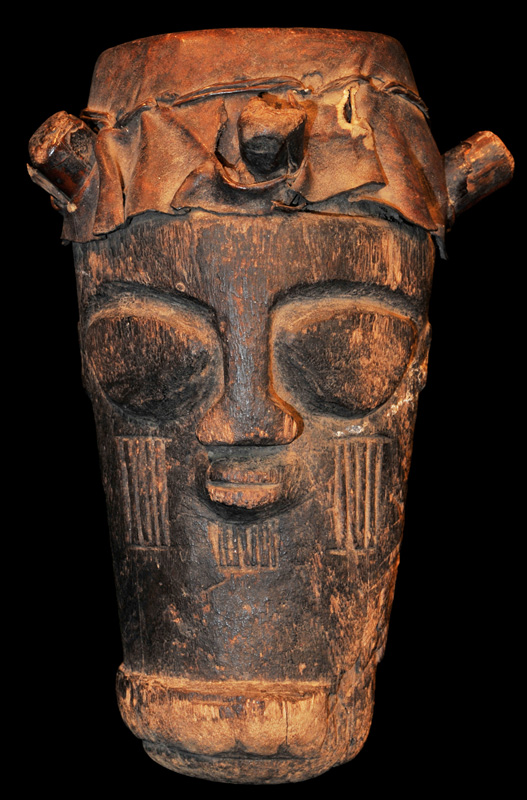
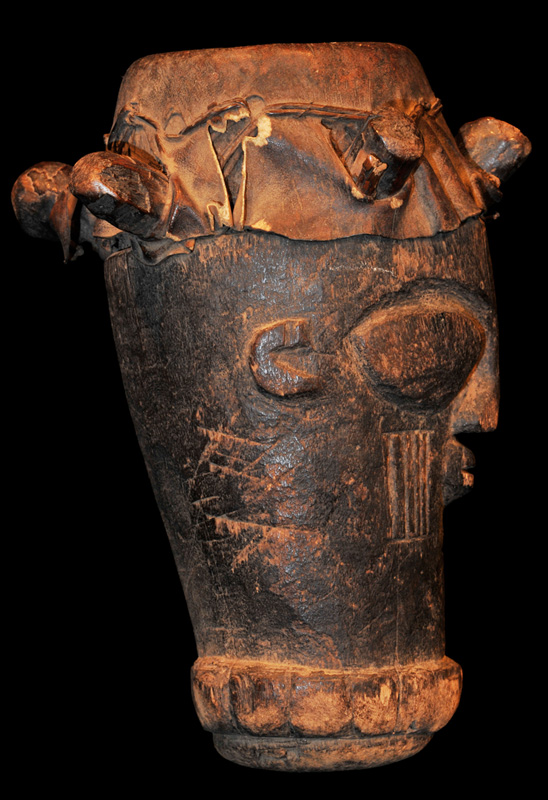
Ipese Drum (Yoruba, Nigeria)
Among the numerous sacred musical traditions of the Yoruba, the Ipese drum occupies a highly specialized position within the religious system of Ifa, the ancient Yoruba tradition of divination associated with Orunmila, the deity of wisdom and knowledge. Unlike many Yoruba drums that accompany royal ceremonies, festivals, dance, or entertainment, the Ipese belongs exclusively to a restricted ritual sphere in which music functions as a medium of spiritual communication and ceremonial practice.
The present example represents the mother drum of the Ipese ensemble. According to Yoruba organological classifications, a complete Ipese set traditionally consists of two closed-bottom Aran drums, one Ipese drum, and a metal bell struck externally with a wooden stick. Within Ifa ceremonies, each instrument fulfills a specific musical function, contributing to a highly structured rhythmic performance that accompanies ritual activities and reinforces the ceremonial significance of the occasion.
Throughout Yorubaland, the Ifa tradition has preserved one of the most sophisticated systems of divination found in Africa. The Babalawo, or Ifa priest, interprets the sacred corpus known as the Odu Ifa through an extensive body of oral literature transmitted over many generations. Music occupies an essential position within this intellectual and religious tradition, and particular drum ensembles are reserved exclusively for specific ceremonies. During Ifa festivals, the use of the Ipese ensemble is considered obligatory, while the substitution of other drum ensembles is traditionally regarded as inappropriate.
The ceremonial function of the Ipese extends beyond festival performance. The ensemble also accompanies the funeral ceremonies of an Ifa priest, where its rhythms serve to honor the deceased and to symbolically separate the world of the living from the realm of the ancestors. According to Yoruba tradition, only initiated members of the Ifa community are permitted to perform on the Ipese, and the symbolic meaning embedded within its rhythmic language can be fully understood only by those who have undergone initiation.
From an organological perspective, the Ipese is a single-headed membranophone carved from a solid section of wood. The body gradually tapers toward the base and is covered with an animal skin attached by wooden pegs and leather bindings. Particularly remarkable is the anthropomorphic design of the present example. The resonator has been transformed into a stylized human face with prominent eyes, a carefully modeled nose, a small mouth, and a carved beard. This artistic treatment reflects an important characteristic of Yoruba visual culture, in which musical instruments frequently function simultaneously as ritual objects and sculptural works.
Early ethnographic studies repeatedly emphasized the inseparable relationship between Yoruba music, religion, and sculpture. The Ipese drum demonstrates that African musical instruments cannot be understood exclusively through their acoustic properties. Rather, they represent multidimensional cultural artifacts that preserve ritual knowledge, oral traditions, artistic expression, and religious practice. Within museum collections, instruments such as the Ipese therefore serve as important witnesses to both the material and the intangible cultural heritage of the Yoruba people.
"During Ifa festival, Ipese is the drum ensemble commonly used. Any other drum ensemble during Ifa festival is inappropriate. Ipese or Ipisi is also used at the burial of an Ifa priest. The main purpose of using Ipese is to give the last respect to the departed soul and at the same time to draw a line between the living and the dead. Only the initiate can beat Ipese and the meaning of what Ipese is saying can only be understood by the initiates."
Azeez Akinwumi Sesan, Gender Dialectics of Yoruba Drum Poetry.
Bankole, A., Bush, J., Samaan, S. H., Anyidoho, K., Alafuele, M. K., Ebong, I. (1975): The Yoruba Master Drummer. African Arts. Regents of the University of California.
Kubik, Gerhard: Musikgeschichte in Bildern – Westafrika. Leipzig 1989.
Laoye I. Timi von Ede: Yoruba Drums. 1959.
McClelland, Elisabeth: The Cult of Ifa among the Yoruba. 1982.
Meyer, Andreas: Afrikanische Trommeln – West- und Zentralafrika. Staatliche Museen Preußischer Kulturbesitz, Berlin 1997.
Sesan, Azeez Akinwumi: Gender Dialectics of Yoruba Drum Poetry.
Thieme, Darius: A Descriptive Catalogue of Yoruba Musical Instruments. Dissertation, Washington D.C. 1969.
Wieschhoff, Heinz: Die afrikanischen Trommeln und ihre außerafrikanischen Beziehungen. Stuttgart 1933.