Himalaya
Damaru Drums Nepal / Tibet
Introduction
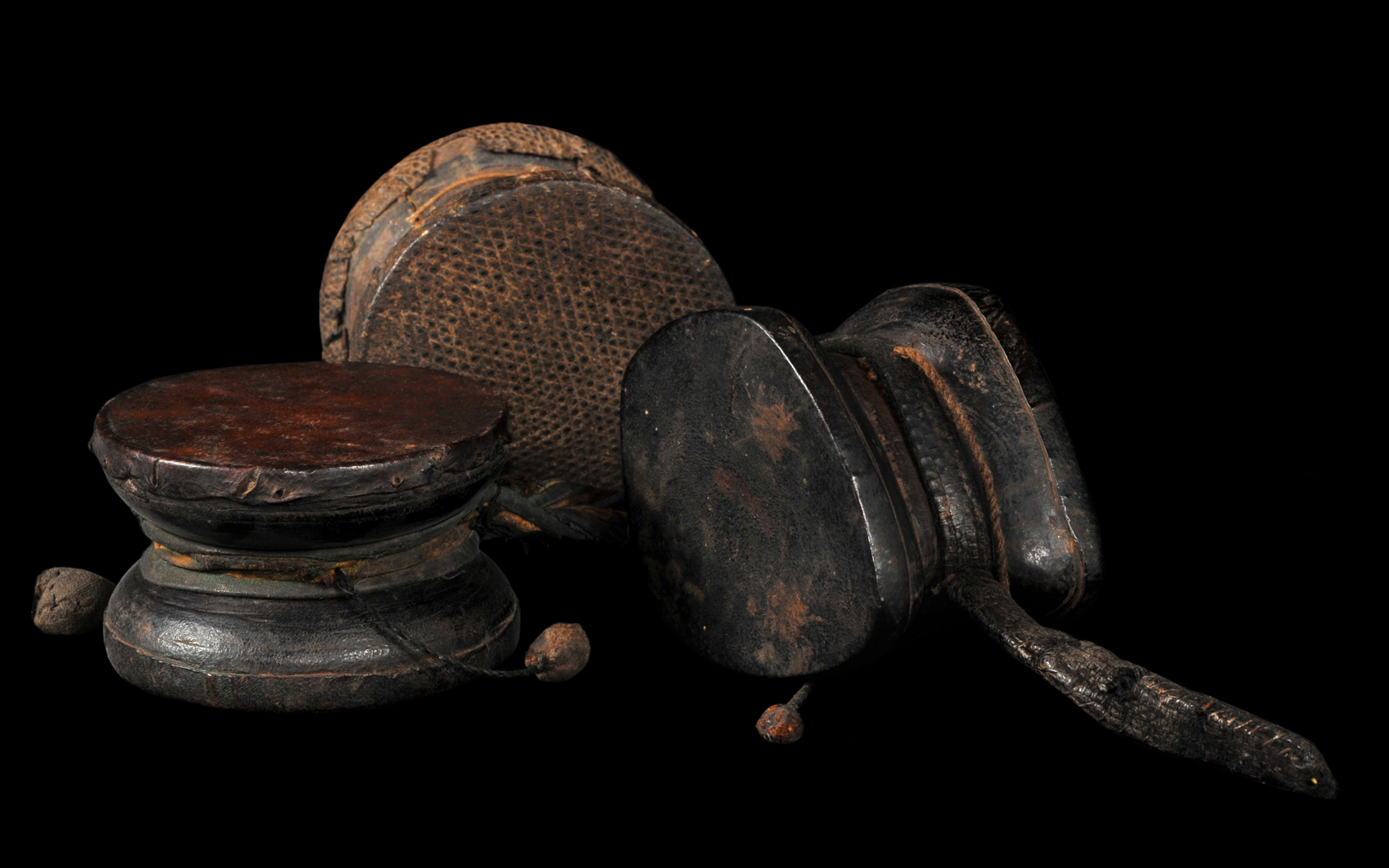
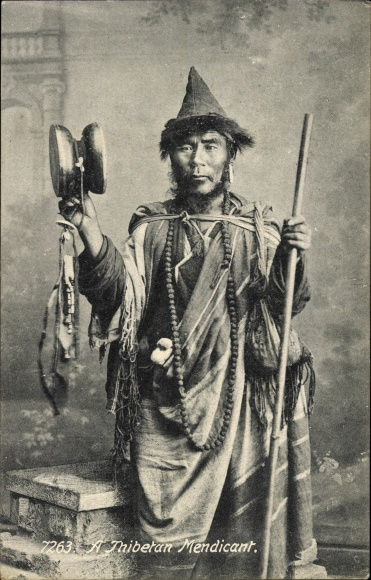
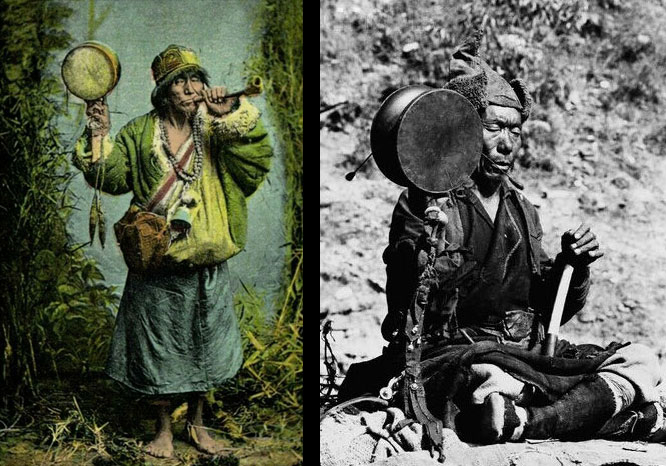
The Damaru is one of the most significant ritual drums of the Himalayan cultural sphere and occupies an important place in both Hindu and Tibetan Buddhist religious traditions. Although small in size, it possesses profound symbolic meaning and is employed in ceremonies, meditation practices, ritual recitations, and tantric liturgies. Throughout Nepal and Tibet, the instrument is regarded not merely as a musical device but as a sacred object whose sound establishes a connection between the material and the spiritual worlds.
Construction
The Damaru is a small hourglass-shaped hand drum with two membranes stretched across its opposing openings. Leather cords attached around the narrow central waist carry small beads or pellets that function as automatic strikers. When the drum is rotated with a rapid twisting movement of the wrist, these strikers alternately strike both drumheads, producing its distinctive pulsating rhythm. Depending on regional traditions and ritual context, Damaru drums may be constructed from wood, carved hardwood, or, in exceptional ritual examples, from symbolic materials reserved for advanced tantric practice.
Ritual Function
The Damaru accompanies ritual chanting, invocations, meditation, and ceremonial dances throughout the Himalayan region. In Tibetan Buddhism it is closely associated with tantric rituals, including the Chöd tradition, where its repetitive rhythms support visualization practices and meditative concentration. Rather than providing musical accompaniment alone, the instrument structures ritual performance, marks transitions within the ceremony, and reinforces the recitation of sacred texts and mantras.
Religious and Cultural Significance
In Hinduism the Damaru is inseparably associated with the god Shiva, whose cosmic drumbeat symbolizes the rhythm of creation, preservation, and transformation. According to Hindu tradition, the primordial sound produced by Shiva's Damaru gave rise to the order of the universe and the origin of language itself. Within Tibetan Buddhism the instrument similarly embodies the dynamic interaction of wisdom and compassion and serves as an audible expression of sacred power during ritual practice. Across both religious traditions, the Damaru represents the creative force of sound, illustrating the central role of music in the communication between human beings and the divine.
Dutta, Krishnendu (2014) A Glimpse of Tamang Musical Instruments. Journal of International Academic Research for Multidisciplinary Impact Factor 1.393, ISSN: 2320-5083, Volume 2, Issue 7
Oppitz, Michael (2013) : Morphologie der Schamanentrommel.
Pannier, F. (2007) : Art chamanique népalais - Nepalese shamanic art. Galerie leToit du Monde.
Manker, Ernst (1938) : Die Lappische Zaubertrommel - Die Trommel als Denkmal materieller Kultur. Acta Lapponica, I
Manker, Ernst (1950) : Die Lappische Zaubertrommel - Die Trommel als Urkunde geistigen Lebens. Acta Lapponica, VI
Hitchcock, John; Jones, R. (Editor) (1976) : Spirit Possession in the Nepal Himalayas.
Mastromattei, R. ; Farano, F. (2006) : Rta. Sciamani in Eurasia. Il rito che sopravvive.