New Guinea
Drum Huon Gulf Area New Guinea
Drum Huon Gulf Area (New Guinea, Papua New Guinea)
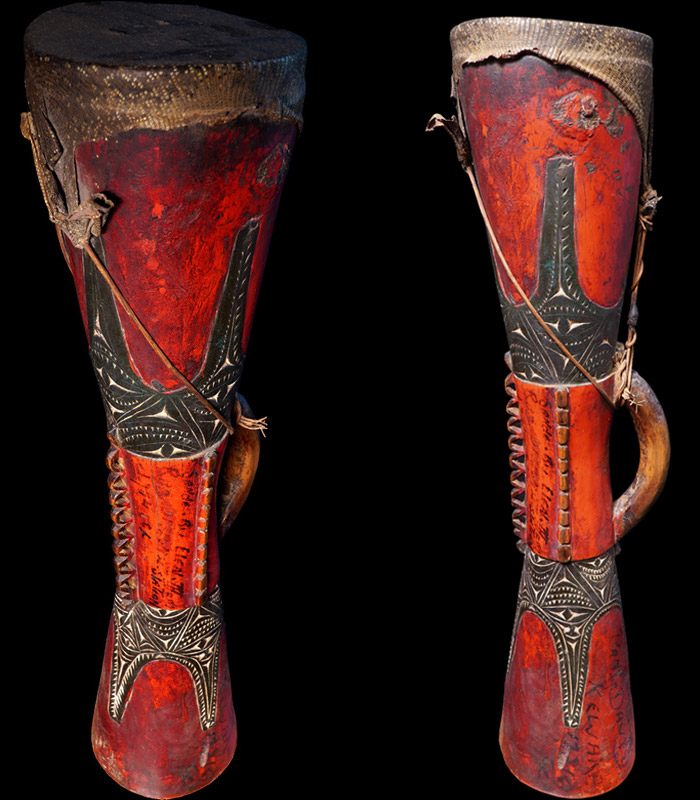
This kundu drum comes from the Huon Gulf area of northeastern New Guinea and represents a characteristic form of drum making from the region. Its elongated hourglass-shaped body, narrow waist and side handle are combined with a richly decorated surface. The drum is particularly distinguished by its strong red-painted ground and the extensive dark carved ornamentation that covers several parts of the body.
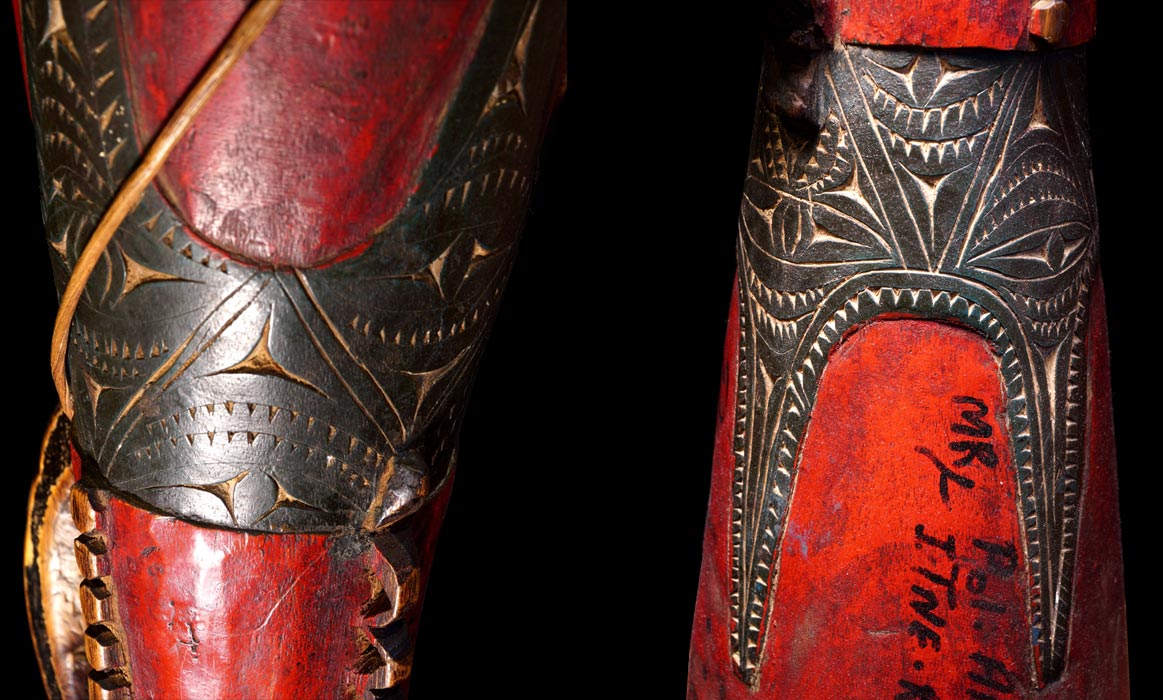
The carved decoration is one of the most striking features of this drum. The deeply incised ornamental bands incorporate clearly recognisable human faces, arranged symmetrically around the body of the instrument. The faces are framed by geometric and serrated patterns and are integrated into the overall carved composition rather than applied as separate decorative elements. Their repeated presence gives the drum a strongly anthropomorphic character. In the cultural context of the Huon Gulf and neighbouring regions, such representations may be understood as references to ancestral beings and to the continuing relationship between the living and the ancestral world. The combination of carved faces, geometric motifs and the vivid red-painted surface gives the drum a particularly powerful visual presence.
The drumhead was traditionally made from reptile skin. In the Huon Gulf region, lizard skin was prepared by drying the fresh hide and later softening it in water before stretching it tightly over the opening. The membrane was secured at the rim with a binding of cane, while plant-based adhesive could be used to help fix the skin to the wooden body. The tension of the membrane was important for producing the characteristic sound of the instrument.
Beeswax also played an important role in the sound production of kundu drums. Small pieces of wax obtained from stingless Trigona bees could be placed on the drumhead to modify its acoustic properties. The tension of the membrane could additionally be adjusted by warming it over a fire, allowing the drum to be brought back to the desired pitch before or during a performance.
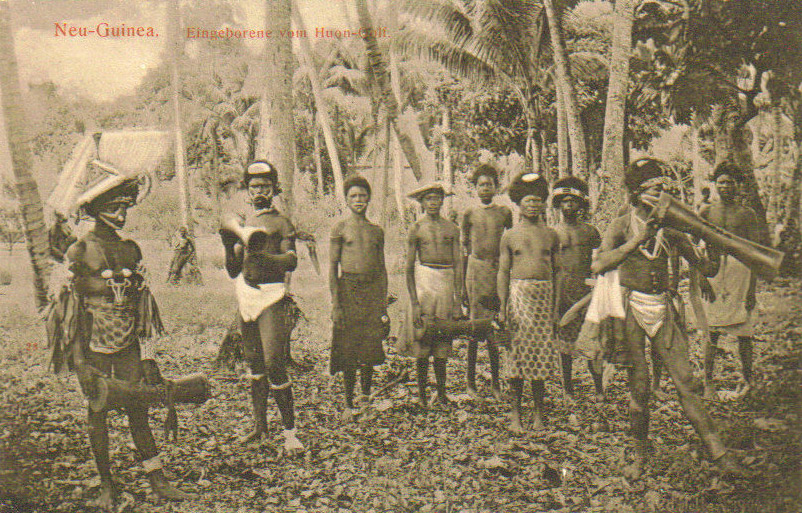
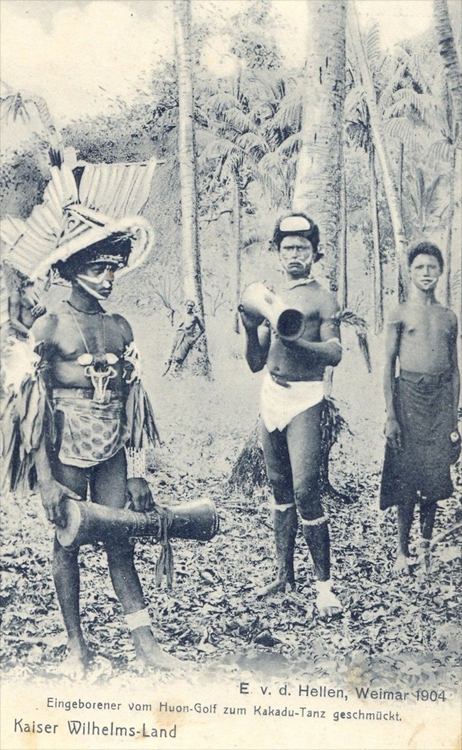
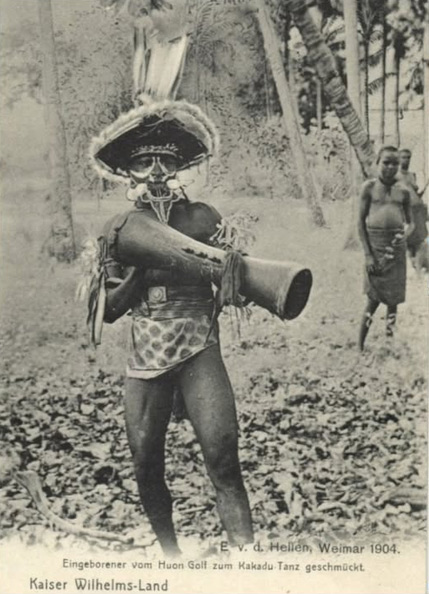
Kundu drums of the Huon Gulf were used to accompany singing, dancing and ceremonial performances. Historical photographs from the former Kaiser-Wilhelms-Land, including photographs associated with the Huon Gulf, document the use of closely related drums in traditional dance contexts. On this particular drum, however, musical function is closely connected with visual and symbolic expression. The carved faces, probably referring to ancestral beings, transform the instrument into more than a sound-producing object: the drum becomes a carrier of memory, identity and relationships between the human and ancestral worlds.
Several previous owners have inscribed their names directly onto the wooden body of the drum. These personal inscriptions are more than simple ownership marks: they form a visible record of the object's history and preserve traces of the different people through whose hands the drum has passed.
"It is a common feature of the drums made in the Huon Gulf area that they are all narrower in the middle and broader toward the ends, that is, they are shaped like hour-glasses. The opening covered by the skin is surrounded by an indented rim, whereas the uncovered opening on the other side has an embossed ring around it. The handle is similar everywhere: a simple open arc, shorter or longer, carved in a flat or cylindrical shape. The drums are ornamented by carving and engraving. The carved parts are on the side opposite the handle, whereas the engraved designs cover the “waist” of the drum in a width corresponding to the length of the handle; other motifs branch out from them toward the top and bottom opening of the drum.(...) Biró tells us that according to the craftsmen the designs on the "waist" of the drum mean bracelets and motifs peculiar to bracelets."
Excerpt from: Bodrogi, Tibor (1961), Art in North-East New Guinea. Budapest: Hungarian Academy of Science, pp. 79–81.
"The skins of the lizards were simply dried and, without any further preparation, rolled up in a bamboo tube. Before use, the skins were softened in water, stretched tightly over the opening of the drum and firmly bound at the rim; the edge hanging out under the binding was pulled from all sides until the drumhead became evenly taut. First, however, the rim of the drum was smeared with the juice of a tree which glued the skin securely to the wood on drying. Another important material was the wax supplied by the stingless Trigona bees, pea-sized pieces of which were rolled and stuck to the drumhead. If these wax pieces were hit, the drum gave a pleasanter sound. During the dance every man had a nut-sized piece of wax stuck to the handle of the drum, to replace pieces which came off. If the skin began to sag during the dance, it was warmed at the fire to make it taut again, and it was occasionally beaten to tune it."
Excerpt from: Bodrogi, Tibor (1961), Art in North-East New Guinea. Budapest: Hungarian Academy of Science, pp. 79–81.
Bibliography:
Bodrogi, Tibor (1961): Art in North-East New Guinea. Budapest: Hungarian Academy of Science.
Dark, Philip J. C. (1974): Kilenge Art and Life. London: Academy Press.
Finsch, Otto (1888): Reisen in Kaiser Wilhelms-Land und Neu-Guinea an Bord des Dampfers Samoa.
Finsch, Otto (1888): Ethnologische Erfahrungen und Belegstücke aus der Südsee: Beschreibender Katalog einer Sammlung im K.K. Naturhistorischen Hofmuseum in Wien.
Craig, Barry (ed.): Living Spirits with Fixed Abodes.
Kunst, Jaap: Music in New Guinea – Three Studies. The Hague: Martinus Nijhoff, 1967.